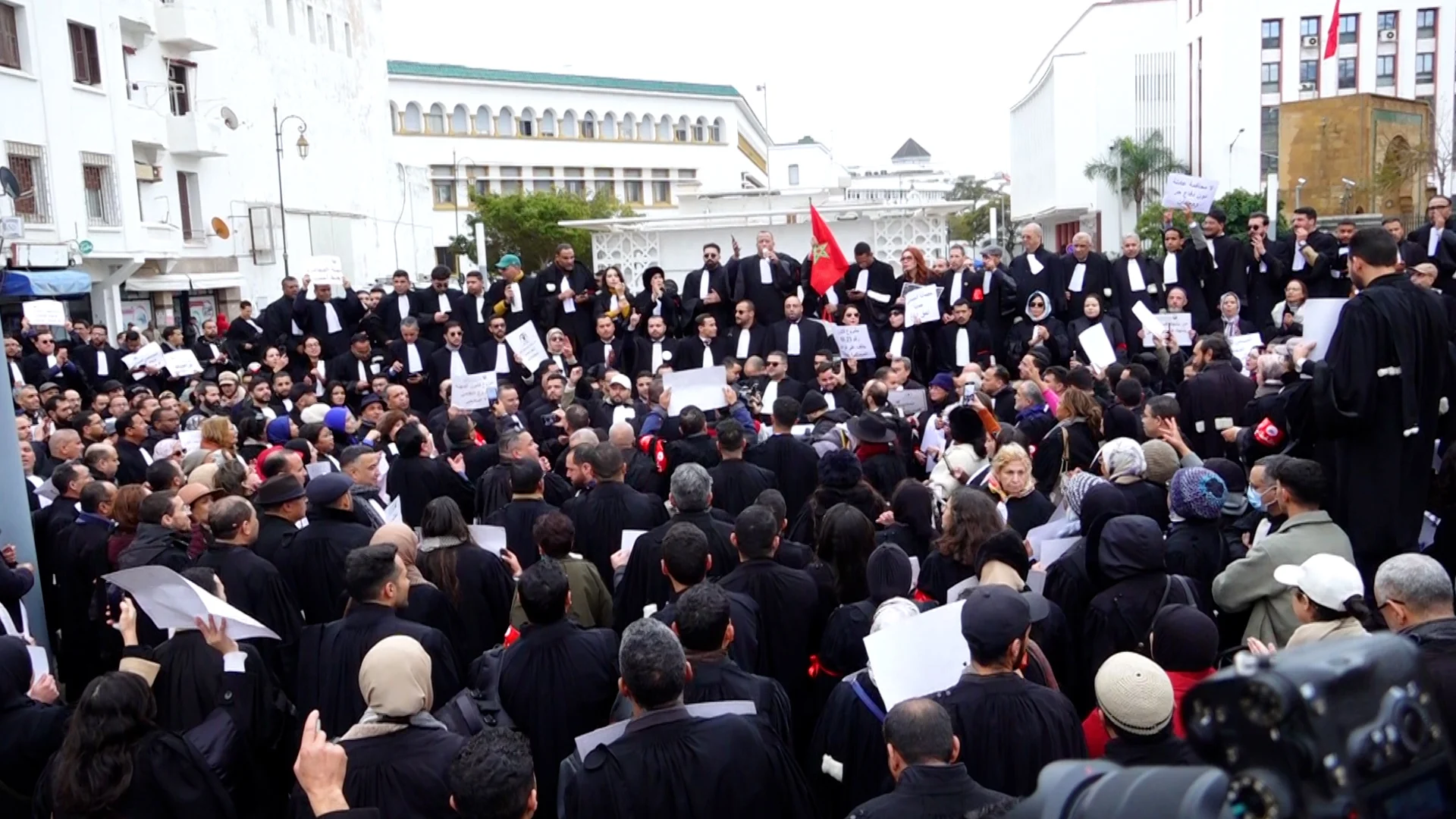
Lawyers have spent more than 100 days on a nationwide strike. Now, a new law has changed many of the rules governing their profession. Law 66.23 has been published in the Official Gazette and replaces Law 28.08. It changes how people become lawyers, how lawyers work, how bar associations are run and how client money is handled.
The law also gives prosecutors a bigger role in disciplinary cases and brings the financial accounts of bar associations under the control of the Court of Auditors.
A law degree is no longer enough to enter the profession.
Candidates must now have a master’s degree, a specialised master’s degree or an equivalent qualification in legal sciences. An equivalent qualification in Sharia law is also accepted.
Candidates must be at least 21 and no older than 45 when they take the entrance exam for the lawyers’ training institute.
Successful candidates will spend one year at the new institute before they can start their traineeship.
The professional traineeship will last 24 months.
Trainee lawyers will spend 20 months in a law firm. They will spend the other four months in a public administration, public institution or state-owned company.
The law also makes continuing education compulsory.
Lawyers who can plead before the Court of Cassation must complete at least 20 hours of training each year, unless they fall under one of the exemptions in the law.
The law also puts tighter controls on money handled by lawyers.
Fees above 10,000 dirhams cannot be paid in cash. Clients must use a cheque or electronic payment.
Lawyers must also give clients a dated, signed and numbered receipt for money or other assets received as part of their work.
Each lawyer must keep detailed financial records, including money received, expenses and other transactions. A separate account must also be kept for each client.
Bar associations must check law firms at least once a year to make sure their accounts and client funds are being handled properly.
A major change concerns money held by lawyers for their clients.
Each bar association must create a deposit and payment account. Client money held by lawyers must pass through this account.
Money awarded to clients through court decisions must also go through the system.
The Court of Auditors will check these accounts. Its checks will cover deposits, withdrawals, transfers, payments, balances, interest and fees.
The system will give public authorities a greater role in checking how client money is handled.
The law also changes how bar associations are governed.
A bar president will serve for three years and cannot be re-elected. A lawyer who has already served as president cannot run for the position again.
Candidates must have at least 20 years of professional experience and must have served at least one term on the bar council.
Bar council members will also serve three-year terms. They can be re-elected only once.
After two terms, they cannot run again.
The law also sets rules for the representation of lawyers based on their years of experience.
Lawyers with more than 20 years of experience will hold 40% of council seats. Those with 10 to 20 years will hold 50%, while those with five to 10 years will hold 10%.
The law also sets minimum representation for men and women.
Neither sex can make up less than one-third of a bar council. An election can be declared invalid if this rule is not respected.
Women can run for ordinary seats or seats reserved for women.
If a male and female candidate receive the same number of votes, the female candidate gets priority. The same rule applies when candidates for bar president receive equal votes.
The new law gives the public prosecutor a stronger role in disciplinary cases.
A bar president must send complaints against lawyers to the relevant prosecutor general within 10 days.
The prosecutor general can challenge some decisions to close cases and can appeal certain disciplinary decisions.
Disciplinary sanctions range from a warning or reprimand to suspension for up to three years or removal from the bar.
A lawyer who continues working while suspended or removed from the bar can be treated as someone unlawfully claiming to be a lawyer.
The law also strengthens some protections for lawyers.
Professional secrecy and the confidentiality of lawyer-client communications remain protected.
The bar president must be informed immediately when a lawyer is arrested or placed in police custody.
Searches and investigations linked to professional offences must follow special rules. They cannot breach the confidentiality of communications between lawyers and their clients.
Any act that breaks these rules is considered legally invalid.
The law also protects lawyers from liability for statements made in court or in written submissions when those statements are necessary for a client’s defence.
This protection does not cover offences such as insult or defamation.
The new law also creates limited opportunities for foreign law firms.
The justice minister can exceptionally allow a foreign firm from a country without a legal convention with Morocco to work on a specific investment project or contract involving a foreign company.
The permission applies only to that project or contract. The foreign firm must also register with the relevant bar and have an address at a Moroccan lawyer’s office.
Moroccan lawyers working abroad can also open another office in Morocco while keeping their foreign practice.
Lawyers cannot advertise their services or directly approach potential clients for business.
They can have a website with the approval of the bar president.
The website can include their education, professional experience, areas of legal interest and published work.
The new law took effect when it was published in the Official Gazette, although some provisions will need additional regulations before they can be applied.
Existing bar councils will remain in place until new councils are elected. The elections are due to take place in December following the law’s entry into force.