
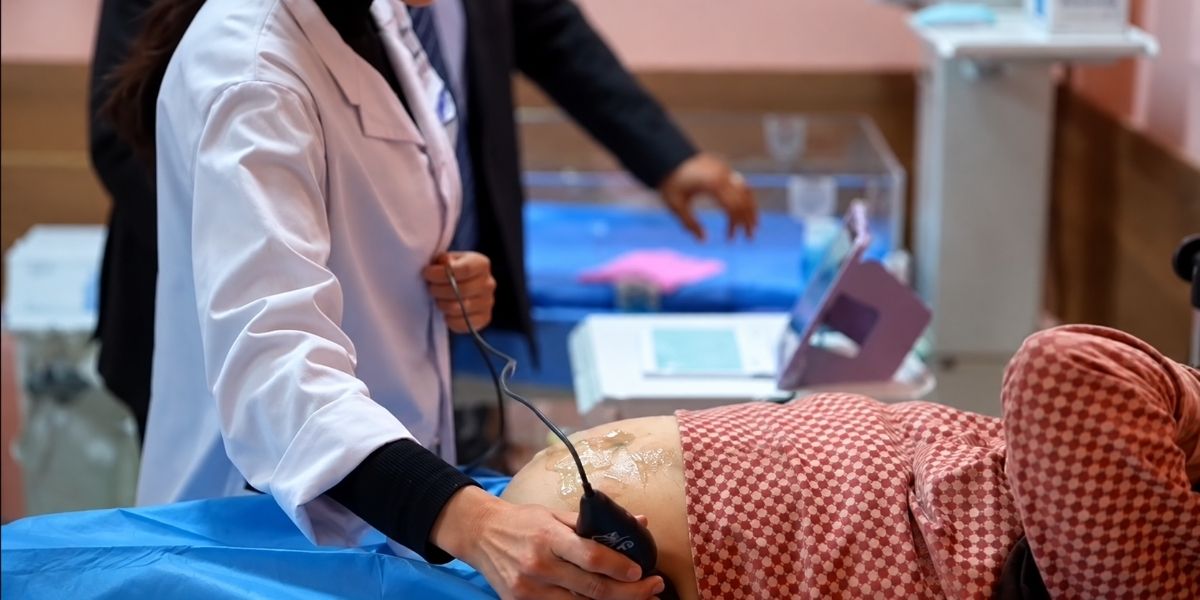
For pregnant women living in remote villages, a routine ultrasound can mean a long journey to the nearest hospital. A new pilot programme is bringing the scan to local health centres instead. Health authorities have expanded an AI-assisted ultrasound programme in the Béni Mellal-Khénifra region after a trial involving 416 pregnant women.
The programme will add 40 health facilities to the 10 centres that took part in the pilot, bringing the regional total to 50. Officials say it is the first step towards a wider national rollout.
The system uses a portable ultrasound probe connected to a tablet. Midwives and other primary healthcare workers follow seven guided steps while AI software analyses the images as they are taken.
The system checks key fetal structures, including the head, spine, heart and placenta, as well as amniotic fluid levels. It can also assist with standard measurements such as head and abdominal circumference and femur length.
A digital report is then prepared for review and approval by a doctor.
During the trial, 27 midwives were trained to use the system and more than 16,500 fetal structures were analysed.
Health workers reported that examination times fell by between 66.7% and 75%. A scan that normally takes about 20 to 30 minutes can be completed in roughly five to 10 minutes, according to the project data.
The technology is aimed at communities where specialist medical care can be difficult to reach. Before the programme, pregnant women in some rural areas travelled an average of 90km (56 miles) for an ultrasound at a regional hospital.
The system can help health workers identify possible complications, including pre-eclampsia, abnormal amniotic fluid levels, irregular fetal heart rates and major congenital malformations.
Women with low-risk pregnancies can continue receiving care locally, while suspected complications can be referred to a specialist.
The AI does not make the final diagnosis. It prepares the images and report for review by an obstetrician or radiologist, who confirms the findings.
The system is also designed for areas with poor internet access. AI processing can take place directly on the tablet, while images and reports can be stored and uploaded to a central health database when a connection becomes available.
Health officials say the approach could reduce unnecessary hospital referrals, cut travel costs for rural families and leave hospitals with more capacity for patients requiring specialist or emergency care.
The expansion is part of wider health-sector reforms focused on strengthening primary care and expanding digital health services.
The programme will also have to overcome practical challenges, including reliable electricity, equipment maintenance, internet connectivity and continued training as healthcare workers move between facilities.
The next phase will bring the AI-assisted ultrasound system to 50 primary healthcare centres across Béni Mellal-Khénifra, with a wider rollout planned afterwards.