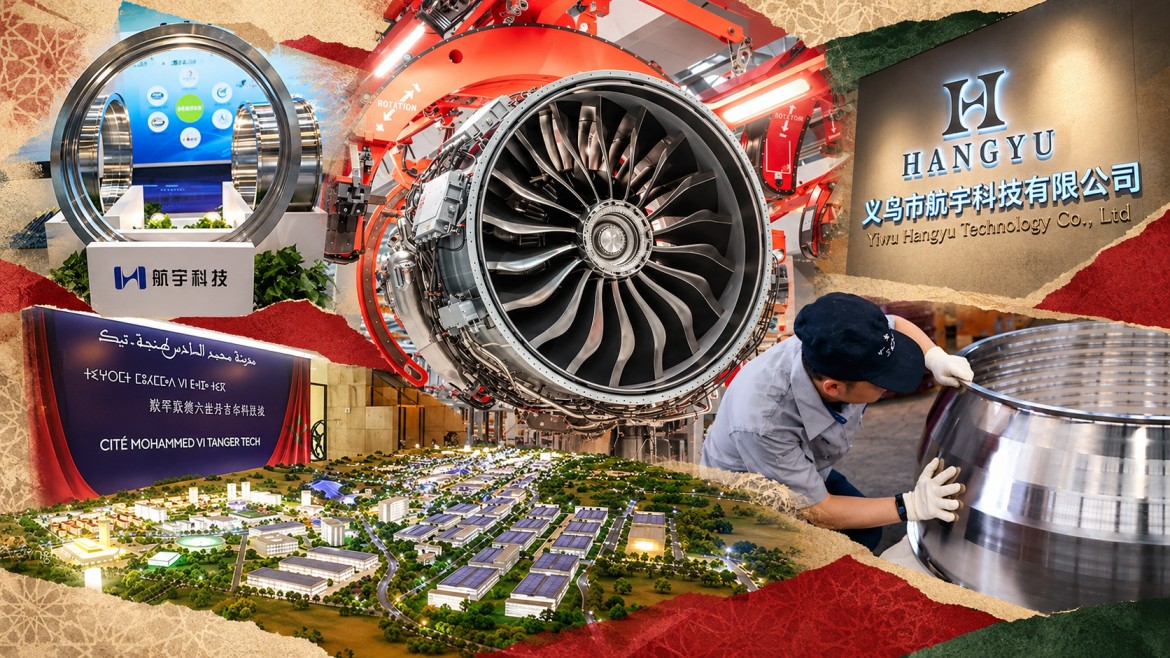
A Chinese company that makes parts for aircraft engines is moving a planned €105m factory from Slovakia to Tangier after delays linked to additional administrative and regulatory checks. Guizhou Aviation Technical Development, known as Hangyu Technology, approved the move on 8 October 2026. The Shanghai-listed company plans to relocate the investment to Mohammed VI Tanger Tech City without changing its budget of 1.15bn dirhams, or about 862m yuan.
The company announced the project in February, with plans to build a factory in Košice, eastern Slovakia, to serve its European customers. But additional regulatory checks introduced by Slovak authorities delayed progress and made the project’s timetable uncertain.
Hangyu has decided to abandon the Slovak site and dissolve the local subsidiary set up for the project. The investment will now be directed towards Tangier, although the new factory remains at an early planning stage.
Hangyu has signed a preliminary agreement expressing its intention to acquire land in Tangier. The final land purchase contract and building permits have not yet been secured.
The company must also complete China’s approval procedures for overseas investment, including registration with the Ministry of Commerce and the State Administration of Foreign Exchange, before the funds can be fully transferred.
Hangyu has approved a capital contribution of 300m yuan, worth about 397m dirhams, to its wholly owned subsidiary, Sichuan Delan Hangyu Technology Development. The money is intended to reduce the subsidiary’s debt burden and help finance a Moroccan subsidiary provisionally named Atlas Advanced Materials.
The original plan in Slovakia covered more than 15 hectares. It aimed to produce 80,000 forged components a year and create 335 direct jobs, with completion targeted for late 2028.
Those targets have not been confirmed for Tangier. Hangyu expects construction to take 36 months after the required permits are granted, but the final production capacity and number of jobs will depend on the site’s design.
Hangyu specialises in precision metal components used in aircraft engines, industrial gas turbines and aerospace structures. Its products include forged rings, turbine discs and structural parts made from metals designed to withstand extreme heat, pressure and rotational forces.
The company does not manufacture complete aircraft engines or industrial machinery. Instead, it supplies components used by major aerospace manufacturers, including GE Aerospace, Safran, Rolls-Royce and Pratt & Whitney. Its products are linked to supply chains serving the CFM LEAP family of aircraft engines.
Its materials include nickel-based and cobalt-based superalloys, titanium and aluminium alloys, and high-strength steel. Its services include precision forging, heat treatment, metallurgical research and testing, and non-destructive inspections to detect defects in components used in safety-critical applications.
More than 40% of Hangyu’s total turnover comes from international markets, according to the figures provided.
Sichuan Delan Hangyu Technology Development reported revenue of 480.8m yuan, equivalent to about 636m dirhams, in the first half of 2026. Its net profit reached 66.5m yuan, or around 88m dirhams.
The subsidiary’s debt-to-assets ratio fell to 81.42%, compared with 85.85% at the end of 2025. The ratio measures the share of a company’s assets financed through debt.
The planned Tangier investment would add to an aerospace industry with established manufacturing centres in Nouaceur, near Casablanca, and Tangier. Aerospace exports reached €2.47bn, up 14.9%, according to the figures provided.
Tanger Tech offers access to the Tanger Med port and international markets through Morocco’s free trade agreements. The industrial zone also has administrative arrangements designed to support foreign investors, including Chinese manufacturers.
The project could strengthen Tangier’s role in aerospace manufacturing, but several steps remain before construction can begin. Hangyu must finalise the land purchase, obtain building permits and complete China’s overseas investment procedures.
The investment budget remains capped at €105m, equivalent to 1.15bn dirhams or about 862m yuan. The company has not announced a revised completion date for the Tangier factory.