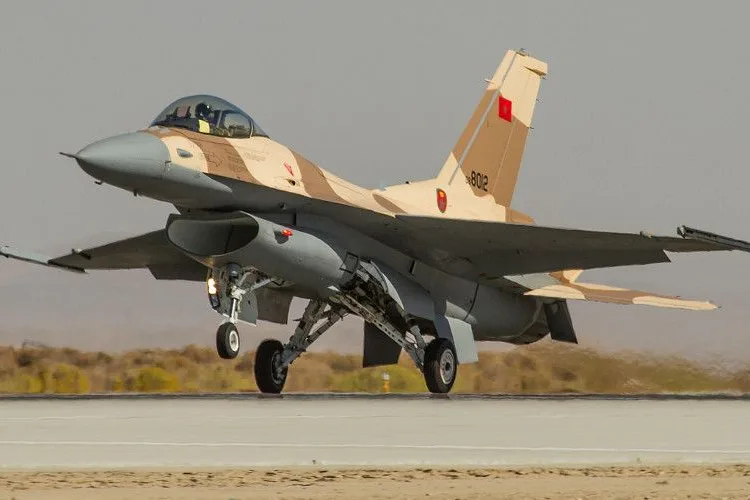
Moroccan pilots have been training to fly and fight when GPS signals fail, radar systems are jammed and communications are disrupted, as part of a French military exercise designed to prepare aircrews for modern warfare. Four Moroccan F-16s took part in Exercise Black Crow 26, held in France from 21 September to 1 October, according to an assessment published by the French Ministry of Armed Forces on 11 October.
The exercise put pilots in conditions where they could not rely on their usual electronic systems to navigate, communicate or detect threats. Jamming equipment and false signals were used to simulate tactics that could be deployed by an enemy during a high-intensity conflict.
The aim was to train aircrews to adapt quickly and continue their missions even when their equipment and communications were under pressure.
Morocco and Belgium sent fighter jets to the exercise. Germany, the United States and the United Kingdom provided real and simulated ground-based air defence systems, while France deployed fighter jets, helicopters, drones, transport aircraft and electronic warfare equipment.
Black Crow 26 involved more than 50 missions, including 180 fighter flights, 50 helicopter flights and 15 transport aircraft flights. Satellites passed over the exercise area about 20 times, while drones also carried out numerous flights.
More than 350 personnel helped organise the exercise, which brought together several hundred military participants.
The drills also gave France’s Defence Procurement Agency, known as the DGA, and defence companies a chance to test equipment in conditions where electronic signals were deliberately disrupted. The tests were designed to show how well the systems performed against advanced electronic countermeasures.
The Black Crow exercise followed another set of manoeuvres, Exercise ORYX, held from 23 September to 2 October at Orange-Caritat Air Base in southern France.
Four Moroccan F-16s and about 50 personnel, including pilots, engineers and support staff, took part. They trained alongside French Rafale fighters in combat tactics, air-to-air refuelling and joint operations.
The exercises exposed Moroccan crews to different aspects of modern air combat, from working with foreign aircraft to carrying out missions when radar, navigation and communications systems are disrupted.
Morocco originally bought 24 F-16 Block 52+ fighter jets under a $2.4bn contract signed in 2008. One aircraft was lost during operations in Yemen in 2015, leaving 23 in service.
The remaining aircraft are being upgraded to the F-16V Viper standard under a US Foreign Military Sales programme worth about $1.08bn. Morocco has also ordered 25 new F-16 Block 72 aircraft.
The upgrade and new aircraft purchases together are valued at about $4.88bn.
The modernised jets are expected to feature the AN/APG-83 active electronically scanned array radar, the Viper Shield electronic warfare system, updated mission computers, Link 16 tactical data links and Joint Helmet Mounted Cueing Systems.
These technologies are designed to help pilots detect threats, share information with other aircraft and protect their jets against electronic attacks.
The wider goal is to improve the Royal Moroccan Air Force’s ability to operate in areas protected by advanced surface-to-air missiles, where radar and communications may be disrupted.
Morocco is a major non-NATO ally of the United States and maintains defence ties with France. Its participation in Black Crow 26 and ORYX provides opportunities to train alongside European forces and practise working with different aircraft and air defence systems.
Modern conflicts have shown that pilots cannot always depend on clear radar signals, reliable GPS navigation or uninterrupted communications. Electronic warfare can interfere with satellite-guided weapons, radar tracking and the exchange of information between military units.
Black Crow 26 was designed to test how aircrews and equipment perform under those conditions. The French defence agency and industry partners also used the exercise to assess technology and countermeasures in a demanding operational environment.