
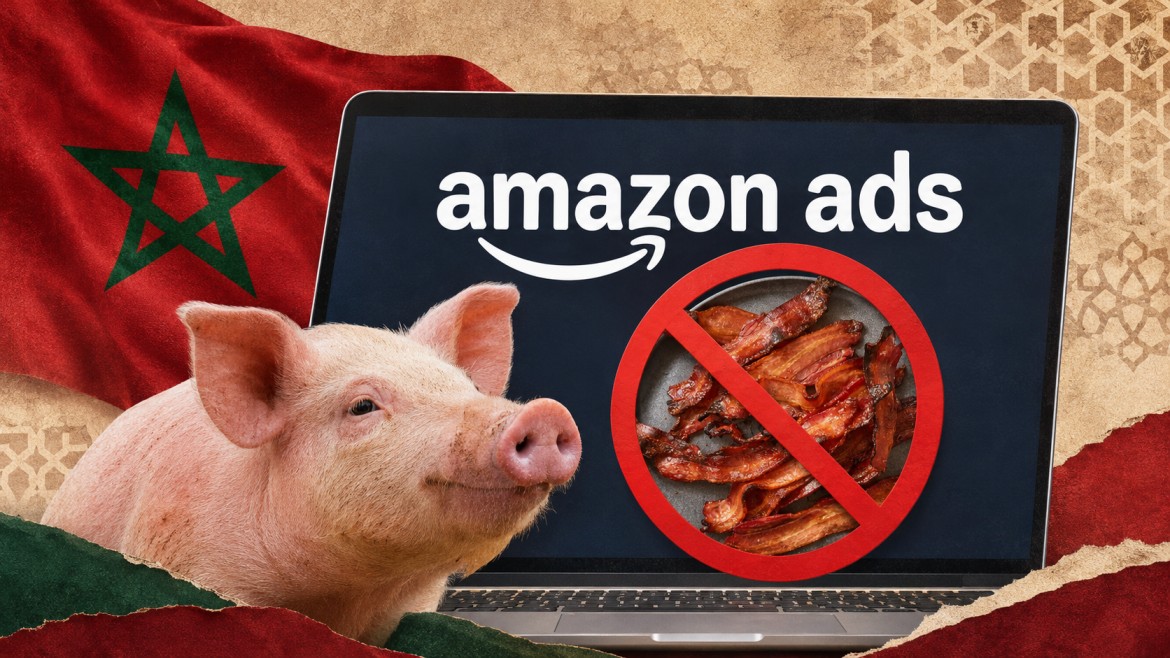
People in Morocco will still be able to see pictures of pigs in online adverts, but promotions for bacon, ham and other pork products are now banned on Amazon’s advertising platforms. Amazon has banned adverts promoting pork products in Morocco and nine other countries, while allowing neutral images of pigs and advertisements for certain non-food items featuring the animal.
The US technology company introduced the restrictions in an update to its advertising guidelines on 15 November 2026. The change extends a ban that previously applied to only three countries: Egypt, Saudi Arabia and the United Arab Emirates (UAE).
The seven newly added markets are Morocco, Jordan, Bahrain, Kuwait, Oman, Qatar and Turkey.
The updated rules cover fresh pork, ham, bacon, pork sausages and other food products made from pork. Advertisements promoting these products will no longer be allowed to appear in the ten countries.
However, Amazon has drawn a distinction between selling pork products and simply showing the animal.
Photographs and illustrations of pigs remain acceptable if they are presented in a neutral and non-offensive way. Non-food products such as piggy banks, toys and stationery featuring pigs can also be advertised, although restrictions apply to where their adverts can appear.
The rules are listed under the “Animal related products and services” section of Amazon’s advertising guidelines. The specialist US publication PPC Land reported the changes on 16 November.
What the ban means for Morocco
Pork is prohibited under Islamic dietary rules, and consumption among Moroccan nationals is virtually non-existent.
However, the sale and import of pork products are permitted under licence for non-Muslim residents, foreign diplomats and international tourists.
Licensed hotels, specialist butchers and designated supermarket sections in cities including Casablanca, Rabat and Marrakech sell these products.
The use of imported pork casings in industrial sausage production has also attracted public attention in the past, raising questions about food ingredients, import controls and product traceability.
Moroccan regulations require food imports and animal-derived products to meet health and safety standards. The National Office for Food Safety (ONSSA) oversees these requirements under Law 28-07, while audiovisual advertising is governed by Law 77-03 and consumer protection rules under Law 31-08.
Amazon’s decision concerns what companies can advertise on its platforms. It does not introduce a new ban on the sale of pork products in Morocco.
Ten countries and more than 305 million people
The updated policy increases the number of countries covered by Amazon’s pork advertising restrictions from three to ten, an expansion of 233%.
The ten countries have a combined population of about 305.4 million, according to estimates based on national census figures and United Nations data.
That is almost twice the 157.5 million people covered by the previous restrictions in Egypt, Saudi Arabia and the UAE.
Egypt has an estimated population of 114 million, followed by Turkey with 85 million, Morocco with 36.8 million and Saudi Arabia with 33 million.
The remaining markets include the UAE, with 10.5 million people; Jordan, with 11.5 million; Oman, with 5.1 million; Kuwait, with 4.9 million; Qatar, with three million; and Bahrain, with 1.6 million.
Morocco alone has about 33.5 million internet users, representing an estimated internet penetration rate of 91% in 2024-25.
The country does not have a dedicated Amazon retail website. Consumers can nevertheless order products through Amazon’s international shipping service.
Six of the seven newly added markets – Morocco, Jordan, Bahrain, Kuwait, Oman and Qatar – also lack dedicated Amazon retail websites. They rely on cross-border shopping services and advertising channels such as Prime Video and Twitch.
Only four of the ten countries have local Amazon retail platforms: Egypt, Saudi Arabia, the UAE and Turkey.
Why the change matters to advertisers
The new restrictions could affect international food companies, consumer goods brands and advertising agencies running campaigns across several Middle Eastern and North African markets.
Companies will need to check their product listings, photographs and advertising materials to ensure they comply with local restrictions. Campaigns that violate the rules risk being rejected by Amazon.
The company uses automated systems to review advertising content, including technology that analyses written material and images, alongside human reviewers.
The distinction between prohibited food products, acceptable images of pigs and restricted non-food merchandise allows Amazon to block specific products without automatically rejecting every advert featuring the animal.
The change also reflects the growing importance of cultural and religious considerations in digital advertising across the region.
A growing advertising business
Amazon’s advertising operations have expanded significantly in recent years.
The company generated $56.2bn in advertising revenue worldwide in 2024, compared with $46.9bn in 2023. That represents an annual increase of nearly 20%.
Its advertising business includes sponsored product listings, display advertising and campaigns delivered through Amazon DSP, Twitch and Prime Video.
The wider Middle Eastern and North African digital advertising market is worth more than $6bn a year, with Saudi Arabia and the UAE accounting for a large share.
In Morocco, total annual advertising spending is estimated at between $350m and $450m, with digital platforms accounting for about 35% to 45% of the market.
The financial impact of excluding pork advertisements in Morocco is likely to be limited because domestic demand is very small. The wider commercial concern is protecting advertisers from having their brands appear alongside content that could conflict with local cultural and religious values.
Amazon follows regional restrictions
Amazon’s updated rules bring its advertising policy closer to restrictions already applied by other major technology companies.
Google and Meta use location-based advertising rules to restrict products that conflict with local laws and cultural requirements. Their policies include restrictions on pork and alcohol promotions in Gulf markets.
TikTok also maintains a regional list of prohibited products that blocks pork, alcohol and gambling advertisements across Gulf Cooperation Council countries, Egypt, Jordan, Morocco and Turkey.
Amazon’s latest update closes a gap in its previous policy, bringing seven additional markets under the same restrictions.
The company began building its regional retail presence in 2017, when it acquired Dubai-based online shopping platform Souq.com for $580m.
It subsequently launched Amazon’s Turkish marketplace in September 2018 and replaced Souq’s regional platforms with Amazon websites in the UAE in 2019, Saudi Arabia in 2020 and Egypt in 2021.
Pork advertising restrictions initially applied to those three Arab markets. The November 2026 update extends them to Turkey and six additional Arab countries.