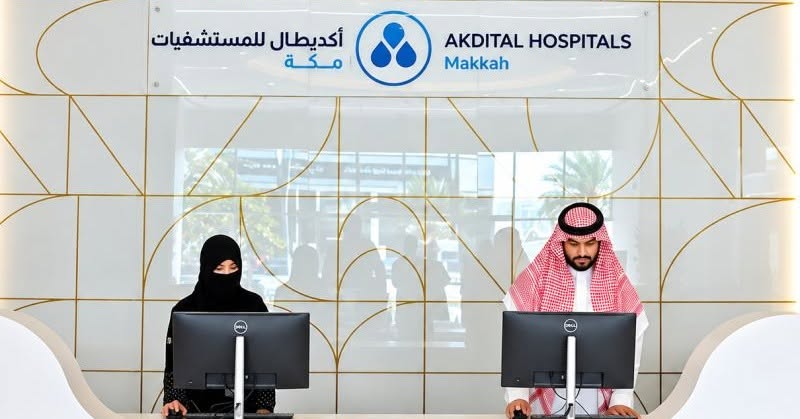
Patients in Makkah will have a new hospital to turn to after Moroccan healthcare group AKDITAL opened a 120-bed facility in the Saudi holy city, marking a major step in its expansion beyond North Africa. Called AKDITAL Hospitals Makkah, the new hospital offers specialist consultations, surgery, emergency care and intensive care. It is also equipped with medical imaging technology and laboratory testing services.
The hospital will serve Makkah’s permanent residents as well as the millions of people who visit the city for Hajj and Umrah pilgrimages.
AKDITAL said the opening was part of its plan to expand in Saudi Arabia and supported the goals of Saudi Vision 2030, the kingdom’s programme to transform its economy and healthcare system and give private companies a bigger role in providing medical services.
The launch marks a shift from expansion plans and partnership agreements to operating a physical hospital in the Gulf.
A growing international business
AKDITAL, headquartered in Casablanca and listed on the Casablanca Stock Exchange under the ticker AKT, has built a network of more than 35 healthcare facilities and around 4,100 beds across Morocco.
The group was founded by its chief executive, Dr Rochdi Talib. It raised 1.2bn Moroccan dirhams (about $115m) through its stock market listing in December 2022.
It then secured another 1bn dirhams through a capital increase in July 2024 to finance further expansion.
AKDITAL’s revenue nearly doubled between 2022 and 2023, rising from 1.03bn to 1.91bn dirhams. It exceeded 2.9bn dirhams in 2024.
Its earnings before interest, tax, depreciation and amortisation (EBITDA) margin has remained between 25% and 27%.
The group generated all its revenue in Morocco before turning towards international markets in 2024 and 2025.
Its expansion plans include Saudi Arabia and the United Arab Emirates, with projects targeting Riyadh, Jeddah, Makkah and Dubai. AKDITAL has set a medium-term target of operating more than 1,000 beds across the Gulf.
The group has not disclosed how much it spent on the Makkah hospital or how much of the investment was covered by local partners.
Why Saudi Arabia matters
Saudi Arabia is the Middle East’s largest healthcare market, accounting for about 60% of healthcare spending across the Gulf Cooperation Council (GCC). Annual spending on healthcare in the kingdom exceeds $65bn.
The country has around 2.2 hospital beds for every 1,000 people. That compares with about 4.3 in countries belonging to the Organisation for Economic Co-operation and Development (OECD) and roughly one bed per 1,000 people in Morocco.
A growing population, rising rates of diabetes and heart disease, and compulsory private health insurance for expatriates and private-sector employees are helping drive demand for hospital services.
Makkah offers an additional opportunity because of its large number of religious visitors.
The city has a permanent population of around 2.4 million. More than 13.5 million foreign Umrah pilgrims and about 1.8 million Hajj pilgrims visited annually, according to figures from Saudi authorities for the 2023-2024 reporting cycles.
That creates demand for emergency treatment and other medical services, particularly during busy pilgrimage periods.
Competition from established hospital groups
AKDITAL is entering a market where major Saudi healthcare companies already have a strong presence.
Its competitors include Dr Sulaiman Al Habib Medical Group (HMG), Mouwasat Medical Services, Dallah Healthcare and Middle East Healthcare Company, which operates under the Saudi German Health brand.
These companies have much larger hospital networks and established relationships with healthcare insurers.
Dr Sulaiman Al Habib, headquartered in Riyadh, operates more than 2,500 beds and is expanding towards 4,000. Its business includes private hospitals, digital healthcare services and pharmacies. Its market value is estimated at more than $25bn.
Mouwasat operates more than 1,600 beds, with a strong presence in the Eastern Province and Medina.
Saudi German Health has around 1,800 beds across its Saudi network and operates in several countries, including the UAE, Egypt and Morocco. It has an established presence in Jeddah and Makkah.
Dallah Healthcare operates more than 1,300 beds and is expanding beyond Riyadh into other parts of the kingdom.
AKDITAL, by comparison, has around 4,220 beds when its new Makkah facility is included. Its strategy relies on standardised hospital development, relatively lean operations and experience gained in the Moroccan private healthcare market.
The financial opportunity and risks
The new hospital could eventually generate between $21.6m and $30m in annual revenue, based on industry estimates for Saudi private hospitals operating at 70% to 80% capacity.
That would translate into roughly 216m to 300m dirhams a year, assuming an exchange rate of 10 dirhams to the dollar.
Such revenue would represent between 7% and 10% of AKDITAL’s 2024 group revenue.
These are estimates based on industry benchmarks, not revenue forecasts published by AKDITAL.
Building a new hospital in Saudi Arabia typically costs between $350,000 and $500,000 per bed. A 120-bed facility could therefore require between $42m and $60m in total construction investment, equivalent to 420m to 600m dirhams.
AKDITAL has previously indicated that its Gulf expansion could follow an asset-light or co-investment model. Under this approach, local property developers finance the hospital building, while AKDITAL pays for medical equipment, technology systems and clinical operations.
If that model applies to Makkah, the group’s equipment and fit-out costs could range from $100,000 to $150,000 per bed. For the 120-bed hospital, that would mean an estimated investment of $12m to $18m, or 120m to 180m dirhams.
The hospital could also need between 420 and 540 employees. This estimate is based on the staffing requirements of multidisciplinary hospitals that provide emergency and intensive care around the clock.
The company has not confirmed its investment amount, staffing numbers, initial occupancy targets or the date when it began admitting inpatients.
How the hospital will make money
Private hospitals in Saudi Arabia rely heavily on agreements with health insurance companies to attract patients and generate revenue.
Major insurers include Bupa Arabia, Tawuniya and Medgulf. Government referrals from the Ministry of Health can also provide additional patients, particularly during peak pilgrimage periods.
AKDITAL has not confirmed whether its Makkah hospital has signed agreements with these insurers.
The hospital’s performance will depend partly on how quickly it attracts patients, secures insurance contracts and builds a team of qualified medical professionals.
Operating costs are another challenge. Medical salaries and regulatory expenses are generally higher in Saudi Arabia than in Morocco. The hospital will need to keep its beds occupied and attract patients requiring specialised procedures to maintain healthy profit margins.
Earning revenue in Saudi riyals could offer some financial protection. The currency is pegged to the US dollar at 3.75 riyals to one dollar, helping the group diversify its earnings beyond the Moroccan dirham.
It could also provide a natural hedge against some medical equipment purchases priced in dollars and euros.
Saudi Arabia’s healthcare reforms
The expansion comes as Saudi Arabia seeks to increase the private sector’s share of healthcare expenditure from around 40% to 65% by 2030.
The target forms part of the Health Sector Transformation Programme, itself a key element of Saudi Vision 2030.
The government wants private companies to play a bigger role in providing medical services, while public institutions increasingly focus on regulation and insurance financing.
Saudi Arabia allows foreign investors to own 100% of healthcare businesses through the Ministry of Investment, subject to licensing and regulatory requirements.
Foreign operators must obtain clinical licences from the Ministry of Health and accreditation from the Saudi Central Board for Accreditation of Healthcare Institutions (CBAHI). They must also integrate with NPHIES, the kingdom’s national health insurance platform.
Companies must comply with Saudisation rules, which require them to employ Saudi nationals in administrative, nursing and other healthcare positions.
These requirements could make recruitment and day-to-day operations more challenging for a foreign operator entering the market.
A test for AKDITAL’s Gulf ambitions
AKDITAL’s international expansion follows several years of rapid growth at home.
After its 2022 stock market listing, the group accelerated hospital openings across Moroccan cities, including Agadir, Tangier, Fez, Marrakech, Oujda and Laayoune.
It opened between nine and 12 facilities a year during its domestic expansion drive, targeting cities and regions with limited private healthcare provision.
The group is now seeking to apply the same hospital development and management model outside Morocco as it looks for new sources of growth.
Its move into Makkah also reverses a familiar pattern in which Gulf-based healthcare companies expanded into North Africa.
Saudi German Health, for example, has developed operations in Egypt and Casablanca.
AKDITAL’s challenge will be to show that a healthcare business built in Morocco can compete in a wealthier but more expensive and tightly regulated market.
The Makkah hospital will be an early test of its ability to recruit medical professionals, meet Saudi employment requirements, secure insurance contracts and attract enough patients to make the investment profitable.