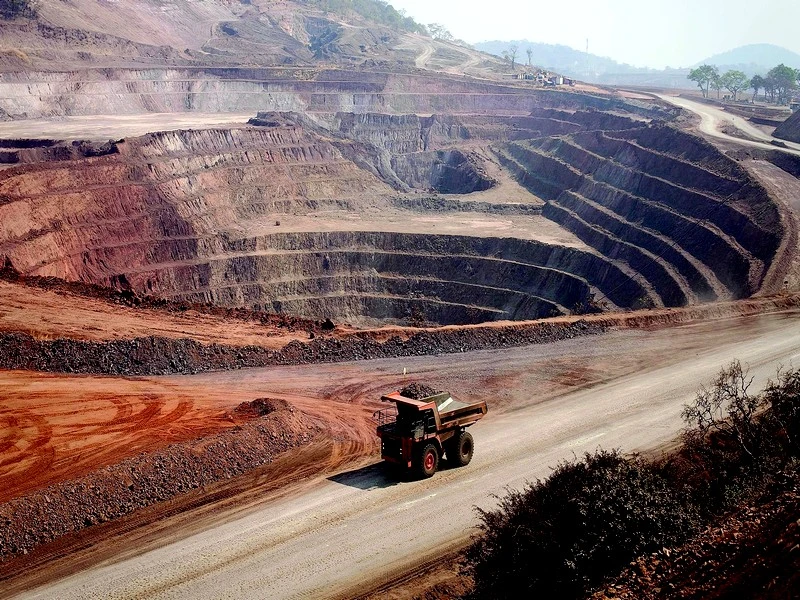
A British mining company says it has found promising copper and silver deposits in southern Morocco, with some samples containing nearly 4% copper and 90 grams of silver per tonne of rock. Critical Mineral Resources said the latest drilling results from its Agadir Melloul project in the western Anti-Atlas region showed mineral deposits relatively close to the surface, raising hopes of developing the site into a producing mine.
The company reported copper grades of up to 3.8% and silver concentrations of up to 90 grams per tonne in its latest exploration campaign.
One drilling hole revealed a 2.2-metre section containing 2.5% copper and 77 grams of silver per tonne. The mineralisation started at a depth of 18.35 metres.
A narrower section in the same hole returned higher grades, with 3.8% copper and 90 grams of silver per tonne over 0.6 metres.
Other findings included:
- An eight-metre section containing 1% copper and two grams of silver per tonne, starting at a depth of 22.6 metres.
- A 1.6-metre section with 1.7% copper and six grams of silver per tonne.
The results came from 15 additional exploration holes drilled to establish the extent of the mineral deposits and build a clearer picture of the geology.
Critical Mineral Resources has also reduced the distance between drilling points from 100 metres to 50 metres in a targeted area. This means the company can examine the deposits in greater detail and improve the accuracy of its future estimates.
More than 10,000 metres of drilling
The Agadir Melloul project covers about 65 sq km and includes exploration permits and a mining licence. It is located around 250km south-west of Marrakech and 240km from the port of Agadir.
The company has so far built a database covering 247 drilling holes: 219 diamond-drilled holes and 28 reverse-circulation holes.
Together, these represent 10,124 metres of drilling.
It plans to drill another 35 holes, covering about 1,750 metres, to gather the information needed to calculate the site’s first mineral resource estimate.
A mineral resource estimate is an assessment of how much copper, silver and other minerals may be present in the ground. It is an important step in determining whether a mining project could become commercially viable.
The company has also received laboratory results for 2,107 core samples analysed by Afrilab in Morocco, as well as about 360 quality-control samples.
These tests are used to measure mineral concentrations and check the reliability of the exploration data.
Silver discoveries open another possibility
The latest exploration work has also identified signs of higher silver concentrations north and north-west of previously investigated areas.
The company believes the findings could be linked to a geological fault, although more drilling is needed to understand its structure and determine how far the silver deposits extend.
Further exploration is planned for 2027 to investigate the area and test whether the higher-grade silver mineralisation continues underground.
The company also intends to advance engineering studies and the licensing process while continuing its exploration work.
Chief executive Charlie Long said the latest results were encouraging and strengthened the company’s confidence in the project.
He highlighted the drilling section containing 2.5% copper and 77 grams of silver per tonne, describing it as particularly significant because it was found relatively close to the surface.
He also said the findings could be connected to high-grade silver discoveries announced in September.
Long said the company wanted to move forward with engineering studies, licensing and drilling at the same time to reduce the time needed to reach production.
The strategy, he explained, was to keep initial investment under control while working towards generating the project’s first operating revenue.
The company hopes the additional drilling and its first mineral resource estimate will help reduce geological and technical uncertainties and provide a clearer picture of the project’s economic potential.
However, the findings are still at the exploration stage. They do not establish proven mineral reserves or guarantee that mining the deposits would be commercially viable. Further technical studies and assessments will be needed before a production decision can be made.