
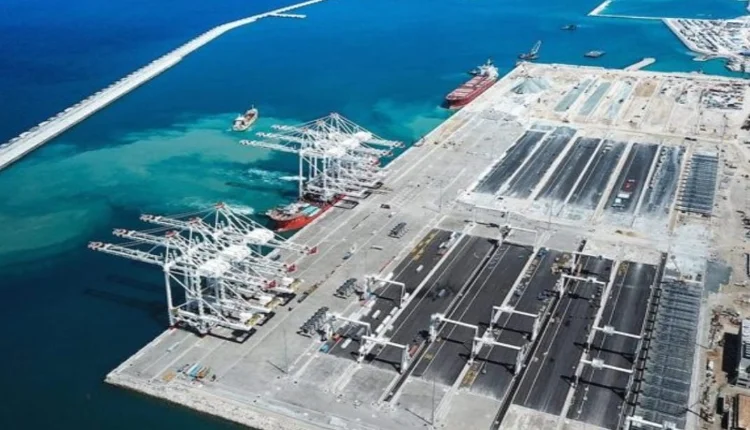
A new desalination plant being built to supply water to businesses at the Nador West Med port has reached an important milestone, with the completion of its coastal seawater pumping station. Chinese engineering group China Haisum announced the completion of the works on Friday, 13 November. The pumping station will bring seawater to the plant, where it will be treated to produce drinking water for the port and its neighbouring industrial and logistics zone.
The milestone does not mean the plant is ready to operate. Equipment installation, connections and testing still lie ahead before water production can begin.
Once fully operational, the facility is expected to produce at least 15,000 cubic metres of drinking water a day. That is enough to fill six Olympic-sized swimming pools, or around 5.5 million cubic metres over a year.
The plant will use reverse osmosis, a process in which seawater is pushed at high pressure through special membranes that remove salt and other impurities.
A different way of drawing seawater
The pumping station is one of the project’s main technical features. Rather than using wells drilled into the beach or long pipelines laid under the sea, the project draws seawater through a pumping station built directly on the shoreline.
China Haisum says this design will make inspections, maintenance and repairs easier and reduce running costs over the plant’s lifetime.
The company describes it as the first desalination project in Morocco to use this type of coastal intake system.
Building the station presented several challenges, including difficult soil conditions and the need to keep seawater out of the excavation site. China Haisum said it examined several designs before settling on the final solution.
The project is being carried out by China Haisum Changsha, a subsidiary of the engineering group, under a contract covering design, equipment procurement and construction.
The agreement was signed in Rabat on 28 October 2024 by Mohamed Jamal Benjelloun, director general of Nador West Med, and Wan Hua, deputy director general of China Haisum Changsha.
The contract’s value and completion deadline have not been made public.
Chinese Ambassador to Morocco Yu Jinsong received an update on the project on 10 November from Ma Jia, commercial director of China Haisum’s international division, and project manager Wang Lin.
She urged the contractor to respect the schedule and meet the required quality standards.
The Chinese Embassy published details of the briefing on Friday, the same day China Haisum announced the completion of the pumping station.
Part of a €240m industrial development
The desalination plant forms part of a wider €240m (£202m) infrastructure programme to develop the Betoya industrial and logistics zone.
The European Bank for Reconstruction and Development (EBRD) has committed up to €110m in financing through Nador West Med Betoya Industrial & Logistic Zone, a wholly owned subsidiary of Nador West Med.
The wider programme also covers industrial and logistics platforms, a wastewater treatment plant, energy-efficient public lighting and electricity infrastructure.
Additional funding includes a €5m grant from the EBRD Shareholder Special Fund, a $3m contribution from the UK and $2.5m from the Global Environment Facility (GEF).
Together, these grants amount to about €10m, or 110m dirhams.
The EBRD has classified the programme as Category B under its environmental rules. This requires further studies into the project’s potential effects on marine life, as well as ecological inspections before certain earthworks can begin.
One concern is the impact of drawing large quantities of seawater and returning concentrated salt water, known as brine, to the sea.
Based on typical seawater reverse osmosis systems, producing 15,000 cubic metres of drinking water a day could require between 33,000 and 37,500 cubic metres of seawater. The process could also produce between 18,000 and 22,500 cubic metres of concentrated brine daily. These are engineering estimates, not figures published by the project developer.
A new industrial hub in the north-east
Nador West Med is being developed as a major port and industrial hub in north-eastern Morocco, around 30km west of Nador. The project aims to attract manufacturing, logistics and export businesses to the Oriental region.
The desalination plant is intended to give these businesses a dedicated water supply rather than increase pressure on water resources used by local households and farmers.
Water availability has become a growing challenge across the country after years of drought and falling dam reserves. The government has accelerated investment in desalination as part of its National Drinking Water Supply and Irrigation Programme, launched in 2020 and running until 2027, with a budget of about 143bn dirhams.
The country aims to increase its desalination capacity to between 1.4bn and 1.7bn cubic metres a year by 2030.
At 15,000 cubic metres a day, the Nador plant will be much smaller than the major desalination facilities planned for Casablanca and Agadir. The Casablanca project, for example, is expected to have an initial capacity of 548,000 cubic metres a day.
The Nador project is different because its water is intended primarily for industrial and port operations, rather than the general population.
A new player in the desalination market
The project also marks a new development in the country’s desalination sector, where European companies have traditionally played a leading role.
Spanish companies, including Acciona and Cox/Abengoa, have been involved in major projects, alongside French groups such as Suez, Veolia and ENGIE.
China Haisum’s involvement gives a Chinese engineering contractor a foothold in a market expected to attract further investment as the country expands its water infrastructure.
The company is part of China Poly Group, a state-owned conglomerate, and operates in engineering, procurement and construction.
The Nador project is also an example of how Chinese contractors can win infrastructure contracts financed by international development banks. The EBRD financing was made available through an international procurement process.
However, several important details remain unknown. Neither the construction contract’s value nor the plant’s expected production cost per cubic metre has been disclosed. Figures for electricity consumption and the volume of seawater the station will draw have also not been published.
Those figures will be important in assessing whether the shoreline pumping system delivers the lower operating costs promised by the contractor.
The plant’s eventual performance will also depend on how quickly businesses move into the Betoya industrial zone and begin using its water supply.