
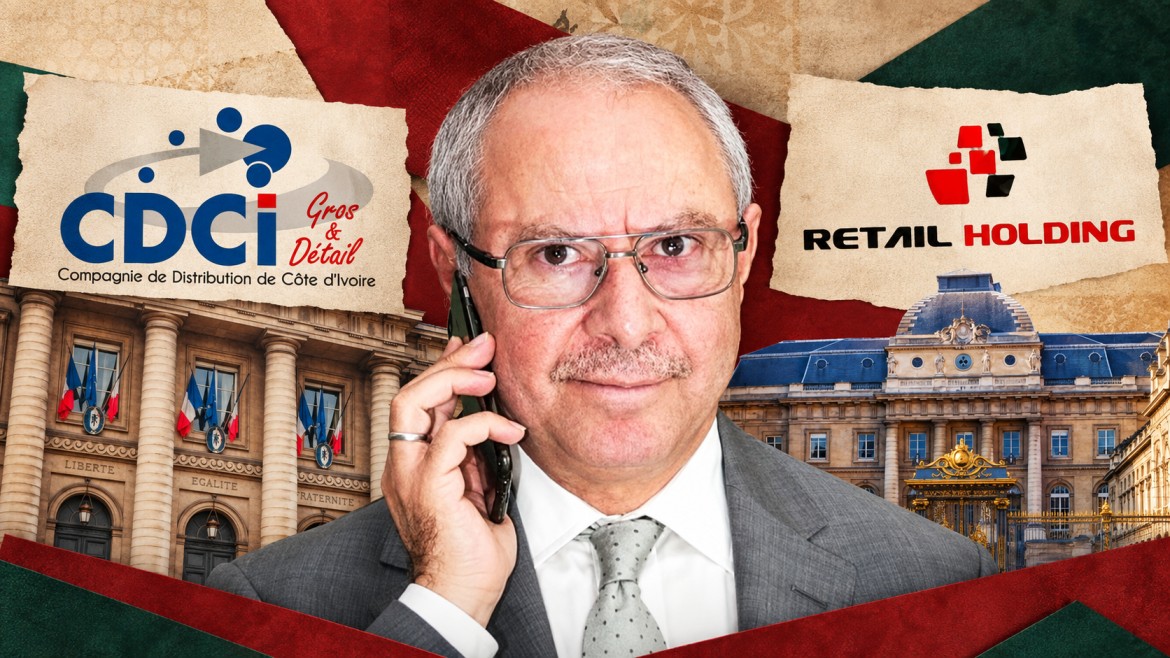
Yasser Ezzedine sold his stake in Ivorian retailer CDCI to Retail Holding Africa in 2019. A few weeks later, he started a new company that competed in the same market. Now that decision could cost him nearly €17m. A French court has cleared the way for Retail Holding Africa to enforce a €16.98m arbitration award against Ezzedine and his holding company, Newmont. Retail Holding can now seek to enforce the award against assets held by Ezzedine and Newmont in France.
The dispute started with a €33.5m deal signed in August 2019. Ezzedine and Newmont sold their 39.99% stake in CDCI to Retail Holding Africa. Retail Holding also bought Amethis’s 25% stake, giving it full control of CDCI.
Ezzedine did not stay out of the retail business for long.
On 21 October 2019, he filed incorporation documents for SOCOCE CI, a new distribution company competing in wholesale and semi-wholesale retail. The company later grew to about 60 stores under brands including Sococé Gros, Sococé Demi-Gros and Procash.
That timing became a key part of Retail Holding’s case.
CDCI relies heavily on wholesale and semi-wholesale distribution to independent traders. Ezzedine had spent years building relationships with suppliers and those traders before selling his stake.
The ICC tribunal found that Ezzedine’s return to the same market interfered with the value of the business he had sold.
The case did not go exactly as Retail Holding had planned.
Retail Holding argued that Ezzedine had broken a five-year non-compete and non-solicitation clause in the sale agreement by creating SOCOCE CI.
The tribunal rejected that argument.
It still found Ezzedine and Newmont liable under a separate rule in French civil law: the garantie d’éviction du fait personnel. The rule requires a seller to let the buyer enjoy the business or asset that was sold without interference from the seller.
That distinction is important.
The tribunal did not find that Ezzedine had broken the specific five-year non-compete clause. It found that his actions breached a separate legal obligation.
The tribunal awarded €15.04m for the fall in the value of CDCI’s shares. It added €1.21m in pre-award interest and €721,580 in procedural costs. It also awarded a symbolic €1 for moral and reputational damages.
The total award was €16.98m, plus $336,750 in arbitration expenses.
Ezzedine and Newmont challenged the award in France.
Their lawyers argued that enforcement would breach international public policy and improperly restrict Ezzedine’s freedom to do business. They also relied on French case law on the need for competition restrictions to remain proportionate.
The Paris court rejected the challenge at the enforcement stage.
The court found that an application to annul an international arbitration award does not automatically stop enforcement. The court also could not use the exequatur process to reopen the arbitration and reassess its economic and legal reasoning.
Retail Holding can therefore pursue Ezzedine’s assets in France while the wider annulment proceedings continue.
SOCOCE CI remains open in Côte d’Ivoire. The French ruling does not give Retail Holding the power to close the company.
The dispute is also about Côte d’Ivoire’s retail market
Ezzedine built CDCI into a major distributor after acquiring the company in 2002.
By 2018, CDCI had about 150 stores, nearly 2,000 employees and annual turnover of roughly €250m, according to the material provided.
The business focused heavily on wholesale, semi-wholesale and proximity retail rather than large premium supermarkets.
Retail Holding entered CDCI in 2014 with Amethis. Five years later, it moved to full ownership.
The group had already built a retail business around restructuring operations and international brands. Its Moroccan operations include Label’Vie, Carrefour, Atacadão, Kiabi and Burger King.
The CDCI deal was meant to strengthen Retail Holding’s position in West Africa.
The emergence of a competitor led by CDCI’s former owner made that plan more difficult.
Bennani is expanding CDCI
Retail Holding is not pulling back from Côte d’Ivoire.
CDCI completed a capital increase in April 2026, taking its equity to 27bn CFA francs (450m dirhams). The International Finance Corporation and Moroccan fund manager Valoris Group joined the shareholder base.
The plan is to increase CDCI’s network from roughly 125 stores to 400 by 2030.
CDCI plans to open 35 new stores in 2026. The company also plans to expand beyond Abidjan into Bouaké, San Pedro, Korhogo and Daloa.
The group wants to triple annual turnover to more than €600m by 2030. It also plans to expand digital services for consumers and independent traders.
The strategy reflects the structure of Côte d’Ivoire’s retail market. Large supermarkets are only one part of the business. Small traders, wholesalers and neighbourhood shops play a major role. The companies that control the supply chain serving those businesses can therefore have a strong position in the market.
SOCOCE CI remains active in Côte d’Ivoire. Ezzedine’s wider legal challenge also continues. The Paris court has now allowed Retail Holding to move forward with enforcement of the €16.98m award in France.
The commercial fight continues in Côte d’Ivoire. The legal fight has now reached Ezzedine’s assets in France.