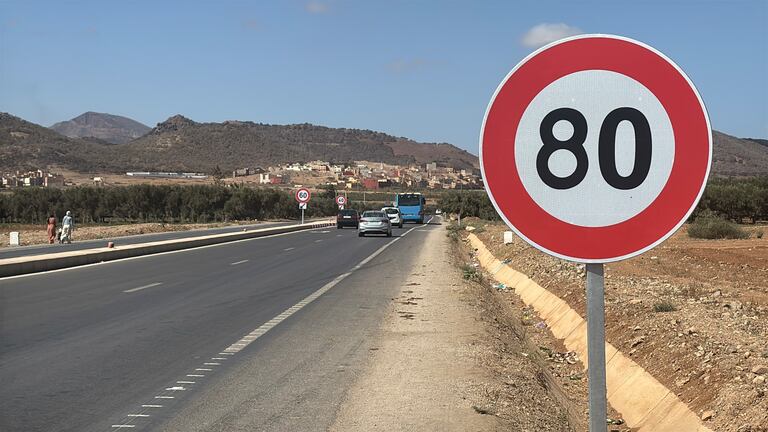
Imagine driving from Casablanca to Tangier and having to keep your speed below 80km/h. The journey would take longer, but your car would use less fuel. If millions of drivers did the same, the country could save significant amounts of petrol and diesel. That is the idea behind a proposal considered in Switzerland, where officials explored temporarily lowering motorway speed limits to 80km/h amid concerns about fuel supplies. The approach could also be considered in Morocco, which imports almost all its energy needs and depends heavily on road transport.
The potential savings are significant. But a nationwide limit would affect the finances of the toll-road operator, the income of transport businesses and the government’s tax revenue.
How much fuel could be saved?
Driving more slowly reduces the energy a vehicle needs to push through the air. Cutting speed from 120km/h to 80km/h reduces aerodynamic drag by about 56%, assuming other conditions remain the same. The effect on fuel consumption is smaller because engines must also overcome tyre resistance and mechanical losses. The source analysis estimates that some conventional cars could use 20-25% less fuel at 80km/h than at 120km/h in favourable conditions.
Actual savings would depend on the vehicle, engine, road conditions, traffic and driving style. Previous experience shows how the savings can vary. In 1974, the United States introduced a national speed limit of 55 miles per hour, or about 88km/h, following the 1973 oil crisis. Estimates suggest the measure reduced fuel consumption across the transport sector by around 1-3%.
Spain temporarily lowered motorway speed limits from 120km/h to 110km/h in 2011, when oil prices were rising. Estimates cited in the source analysis put the eventual reduction in national fuel consumption at about 2-3%.
Why fuel supplies are a concern
Morocco relies on imported refined petroleum products following the closure of the SAMIR refinery in 2015. This leaves the country exposed to changes in oil prices, international refining costs and shipping charges. Disruptions to major supply routes, including the Strait of Hormuz, could make it harder to obtain sufficient fuel.
The country’s strategic reserves provide a buffer. The legal framework has historically required fuel distributors to hold stocks equivalent to 60 days of national consumption. Figures in the source analysis put diesel coverage at around 47-51 days and petrol at about 55 days.
A reduction in fuel consumption of 10-15% could extend the time those stocks last, depending on how much of the national total could be saved and how widely drivers and businesses complied. That extra time could help the authorities arrange alternative supplies during a serious disruption.
Diesel accounts for an estimated 75-80% of Morocco’s vehicle fleet. The vehicle fleet is also growing. New-car sales exceeded 176,000 in 2024 and passed 235,000 registrations by the end of 2025. Hybrid and electric vehicles remain a small part of the market. Slower driving could help electric cars travel further on a single charge because aerodynamic resistance rises sharply at higher speeds.
The financial risk for toll roads
Morocco has nearly 1,800km of motorways, operated by Autoroutes du Maroc (ADM), the state-backed toll-road company. Drivers pay to use these roads partly because they save time. A limit of 80km/h could make some motorists choose free national roads instead, especially if the journey times became more similar.
ADM’s debt stood at about 39.4bn dirhams at the end of 2024. Its annual revenue rose from around 3.3bn dirhams in 2019 to approximately 4.7bn dirhams in more recent figures. A fall in traffic could leave the company with less money to repay its debt and maintain its network. The government might then have to provide financial support or restructure the company’s liabilities.
The Covid-19 pandemic showed how quickly toll-road finances can come under pressure when traffic falls. The source analysis reports declines of 70-90% during the worst periods of restrictions in 2020. An 80km/h limit would have a different effect, but some drivers might switch permanently to alternative roads if they no longer consider motorway tolls worthwhile.
The impact on government revenue
Fuel consumption generates tax revenue through the internal consumption tax, known as the TIC, and value-added tax on imports. Energy-related TIC receipts reached about 16.3bn dirhams in 2021 and remained above 16bn dirhams in 2022. Budget projections for 2025 put the figure at nearly 19.5bn dirhams. VAT collected on imported energy products is also estimated to exceed 18bn dirhams.
Lower fuel sales would reduce these tax receipts. The size of the loss would depend on how much consumption fell, the taxes applied to each product and changes in international prices. The government could also save money. During the inflation surge of 2022 and 2023, it allocated close to 12bn dirhams in support for transport professionals affected by rising diesel prices.
Lower fuel consumption could ease pressure on these businesses and reduce demand for emergency assistance. Reduced imports would also help the trade balance and preserve foreign currency.
Longer journeys for taxis and businesses
Road transport carries an estimated 90% of freight and passenger traffic in Morocco. A lower speed limit could therefore affect a large part of the economy. Heavy goods vehicles are already subject to a maximum speed of 80km/h under Moroccan traffic rules. A lower limit for cars could bring their speeds closer to those of trucks, potentially reducing overtaking and changing traffic flows.
Passenger transport could face higher costs. Morocco’s long-distance coach companies depend on journey times to organise their services, while more than 45,000 grands taxis provide links between towns and cities. Longer journeys could mean fewer trips each day and lower earnings for drivers. Businesses might seek to raise fares, adding to the cost of travel for passengers.
Freight companies could also face delays. Tanger Med is a major gateway for international trade, and the source analysis estimates that around 700,000 international road-freight truck movements take place annually within its wider transport network. Exporters of perishable goods, including fresh produce from the Souss-Massa region, depend on reliable journeys to get their products to market.
Could slower driving make roads safer?
Morocco records an estimated 3,500-4,500 road deaths each year, alongside more than 160,000 reported accidents. The economic cost of road accidents is put at more than 15bn dirhams annually. Lower speeds reduce the energy released in a collision. At 80km/h, a vehicle has about 44% of the kinetic energy it would have at 120km/h, assuming the same mass.
This does not mean deaths would fall by the same proportion. The outcome of a crash depends on road conditions, vehicle design and the circumstances of the collision.
Morocco’s National Road Safety Agency, NARSA, already uses fixed and mobile speed cameras. Enforcing a lower limit would require effective monitoring and compliance. Slower driving could also reduce fuel use and greenhouse-gas emissions. Transport accounts for a substantial share of the country’s energy consumption, while lower fuel use can reduce carbon emissions and some local air pollutants.
What should the government do?
An 80km/h limit could help Morocco stretch its fuel reserves during a serious supply crisis. Its effectiveness would depend on the scale of the shortage, the number of drivers who complied and the share of national fuel use that could be reduced. The government could also consider more targeted speed restrictions, stronger enforcement of existing rules and measures to encourage fuel-efficient driving.
The figures in the source analysis suggest that a blanket limit could bring substantial costs for transport businesses, toll-road finances and public revenue. Those effects would need to be assessed alongside the potential savings in fuel imports and emergency subsidies. In the longer term, expanding rail services, improving vehicle efficiency and increasing the use of electricity generated from renewable sources could reduce the country’s reliance on imported petroleum.
A lower speed limit could provide extra time during a fuel crisis. Reducing the economy’s dependence on imported fuel would require changes that last far longer than the emergency itself.