
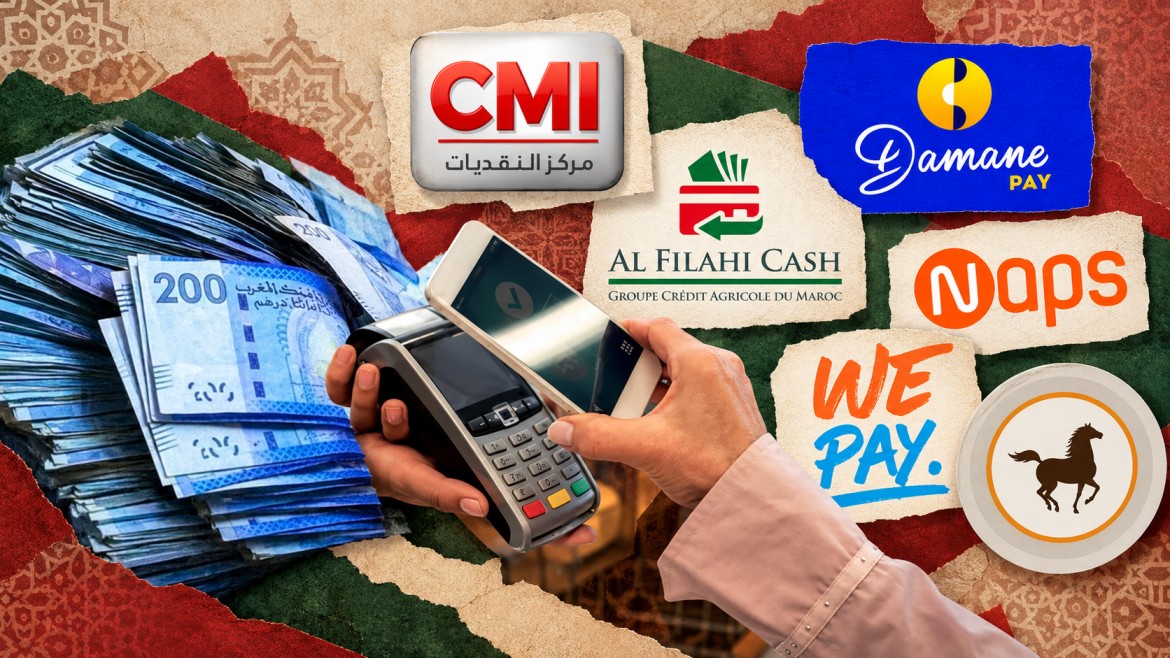
At a bakery in a Moroccan neighbourhood, the most important piece of technology may still be the old-fashioned cash drawer. Coins rattle into it. Banknotes are folded, counted and recounted. At the end of the day, someone has to make sure that what the till says matches what the drawer contains.
For years, this has been the quiet rhythm of commerce in Morocco. A customer buys bread with a few dirhams; a shopkeeper hands back change; the transaction disappears almost as quickly as it began.
Now Morocco is trying to make that rhythm obsolete. From October 1st 2026, the cost of accepting domestic card payments has been cut by the country’s central bank. Bank Al-Maghrib has reduced the regulatory ceiling on domestic card interchange fees from 0.65% to 0.50%. For small “proximity” merchants and government e-services, the ceiling is even lower: 0.15%.
The reform is an attempt to prise Morocco away from one of its oldest financial habits: cash. Banknotes remain so deeply woven into daily economic life that the value of currency circulating outside banks reached more than 484bn dirhams in late 2025 and approached 491bn dirhams. Cash is equivalent to roughly 30% of GDP, according to the material underlying the reform.
That creates a peculiar paradox. Morocco has spent years building a modern banking and payments infrastructure, yet much of its economy still behaves as though the digital revolution happened to somebody else.
The hidden price of a banknote
Cash feels free to the person handing it over. It is not free to the economy. A banknote leaves behind little evidence of where it has been. For a small trader, that can be convenient. For the tax authorities, it is rather less so. Cash-heavy commerce makes it harder to trace transactions, encourages informal activity and limits the visibility of economic exchanges.
There is another, less visible cost. Money held in tills, wallets and envelopes is money that is not sitting in bank accounts. The more currency that circulates outside the banking system, the greater the pressure on financial institutions and, ultimately, on the central bank to maintain liquidity.
Then there is the mundane cost borne by merchants themselves: counting cash, storing it, transporting it and guarding it. Industry estimates cited in the source put cash-management costs at between 1.5% and 3% of retail turnover.
That matters because accepting a card has traditionally carried its own price. For a merchant, a card payment is not simply money moving from a customer’s account into the shop’s account. Behind the apparent simplicity of tapping a card lies a chain of banks, payment networks, switches and processors, each performing a different job and, in some cases, collecting a fee.
The total charge paid by the merchant is known as the Merchant Discount Rate, or MDR. In simplified terms:
MDR = interchange fee + acquiring margin + network and processing fees.
The interchange fee is paid by the merchant’s acquiring institution to the bank that issued the customer’s card. It has historically represented the largest component of the merchant’s payment cost. That is where Bank Al-Maghrib has chosen to intervene.
A cheaper tap for the corner shop
The reform is particularly aimed at the businesses that have often found card acceptance least attractive: the small shop, the bakery, the café and the neighbourhood trader.
Before the reform, merchant commissions could range from roughly 0.7% to 2.5%, depending on the business and its bargaining power. Large retailers could negotiate. Small merchants generally could not.
That created a familiar calculation. If the customer wanted to pay by card for a small purchase, why absorb another fee when cash cost nothing at the till? Some merchants responded by refusing cards altogether or by imposing minimum purchase amounts. The new framework attempts to change that arithmetic.
For qualifying proximity merchants, the interchange ceiling is now 0.15%. The category is deliberately narrow. It includes independent sole proprietors registered under Morocco’s auto-entrepreneur regime with annual turnover of no more than 500,000 dirhams, or taxpayers under the Single Professional Contribution regime with annual turnover of no more than 2m dirhams. Large companies, chains, franchises and integrated commercial establishments do not qualify.
A customer buying a few items from a neighbourhood shop should not face a payment system designed economically for a multinational retailer. If the reform works, the card terminal will become less of a piece of expensive machinery sitting beside the till and more of an ordinary part of the till itself.
The terminal is only the visible part
To understand why this matters, it helps to follow a single card payment. A customer taps a card or phone on a payment terminal. The terminal sends an encrypted request through the acquiring institution’s network. The issuing bank checks whether the card is genuine, whether the account can cover the transaction and whether the payment meets its security requirements.
The transaction is then recorded and, usually at the end of the business day, transmitted through the clearing system. The customer’s bank settles the transaction with the acquiring institution. The merchant eventually receives the money, minus the applicable fees.
Breaking up a two-decade-old structure
The reduction in fees is only one half of the story. The other is competition. For more than two decades, Morocco’s card-acquiring market was dominated by the Centre Monétique Interbancaire, or CMI. Created in 2001 and owned by major Moroccan banks, CMI became the country’s dominant commercial card acquirer and transaction-processing switch, accounting for more than 97% of physical terminal and online gateway activity according to the source.
That structure has now been challenged. Following a complaint by NAPS SA, the Competition Council issued Decision No. 152/ق/2024 in October 2024. The decision required CMI to separate its commercial acquiring activities from its technical processing infrastructure.
From November 1st 2024, CMI could no longer solicit new merchant contracts or expand its direct commercial acquiring business. Its existing merchant portfolio was subsequently transferred to independent payment institutions and bank-owned acquiring subsidiaries. By early 2026, the private merchant portfolio had been divested, while public-sector e-government contracts were reassigned by April 30th.
CMI’s new role is less visible but arguably more important. It is becoming the plumbing rather than the shopfront: a shared technical platform providing processing, clearing and switching services to licensed acquirers on open and non-discriminatory terms.
That changes the market’s architecture. Instead of one dominant commercial gateway, merchants can increasingly deal with a collection of acquiring institutions, including Attijari Payment, M2T, Lana Cash, CDM Pay, Al Filahi Cash, NAPS SA and Barid Cash. Each has its own commercial focus, from large corporate accounts and e-commerce to rural networks, micro-merchants and financial inclusion.
The banks face a different problem
There is an uncomfortable side effect. Lower interchange fees are good for merchants but bad for banks that issue cards if transaction volumes do not rise sufficiently to compensate.
Issuing banks have historically used interchange income to help pay for the machinery behind cards: account administration, fraud prevention, customer services and other infrastructure. Reducing the fee compresses that revenue stream.
The answer is volume. Banks and payment providers now have an incentive to persuade more merchants to accept cards and more consumers to use them. A payment worth a few dirhams may generate little income individually. Millions of such payments could become a different proposition.
This explains why the reform is not simply a technical adjustment to a percentage. It is an attempt to alter the economics of an entire payment ecosystem.
If merchants accept more cards, banks process more transactions. If consumers encounter more terminals, they may use less cash. If more transactions move through formal payment channels, the economy becomes easier to observe. The central bank is therefore making a bet on scale.
A small number can change a big economy
There is, however, no guarantee that lower fees will empty Morocco’s cash drawers. Price is only one reason merchants prefer cash. Habit is another. So is trust. So is convenience. A neighbourhood shopkeeper who has spent years dealing in banknotes will not necessarily abandon them because the cost of card acceptance has fallen.
The reform also prohibits merchants from simply passing payment costs on to consumers. Retailers and service providers cannot impose a surcharge on customers for choosing electronic payment. They must charge the same price regardless of whether the customer pays electronically or in cash.
Acquiring institutions must also disclose their fees contractually, while merchants equipped with terminals must display signs showing which electronic payment methods they accept.
These details may sound bureaucratic. They are not entirely so. They are attempts to remove the small frictions that can kill adoption. A payment system does not become popular because a regulator declares it modern. It becomes popular when using it is cheaper, easier and more predictable than the alternative.
The real test will be at the till
Morocco’s payment reform is ultimately less about banks than about behaviour. The central bank can lower interchange fees. The Competition Council can dismantle market concentration. Payment institutions can install terminals. Technology companies can build ever more sophisticated payment infrastructure.
But the final decision remains with the person standing behind the counter. Will the shopkeeper accept the customer’s card for a 20-dirham purchase? Will the customer reach for a phone rather than a banknote? Will a small business decide that electronic payments are no longer an expensive luxury but simply another way of doing business?
That is the real experiment now under way. Morocco is not trying merely to make card payments cheaper. It is trying to change the economics of an economy that has become unusually comfortable with cash.
The irony is that the revolution may not look revolutionary at all. It may look like a customer buying bread, tapping a card, and walking away.
What changes is what happens afterwards: the transaction leaves a trace, the merchant receives money without counting it, the bank sees another electronic payment, and somewhere in the financial system a few more dirhams remain digital rather than becoming another banknote in another drawer.
Multiply that small moment by millions, and a country’s payment habits begin to change. That, rather than the difference between 0.65% and 0.50%, is the number Bank Al-Maghrib is really watching.