
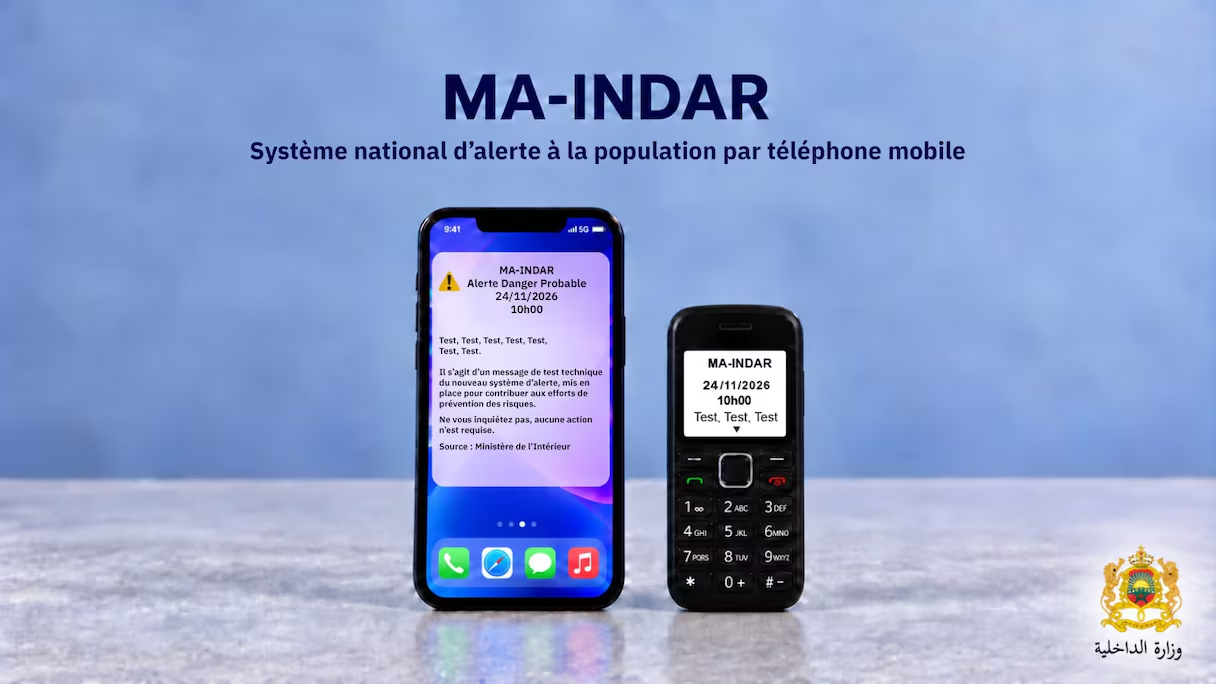
People in seven Moroccan provinces will receive test emergency alerts on their mobile phones this week as authorities prepare to launch a nationwide warning system in December. The system, called MA-INDAR, will send alerts by text message or cell broadcast to phones in areas affected by a potential danger. Cell broadcast messages will appear on compatible phones with a distinctive warning sound.
The Interior Ministry said the system would provide information about the nature of a threat, how serious it is, when it is expected to occur and what people should do.
The alerts will be used only in exceptional situations requiring an emergency response. The ministry aims to reach people in affected areas more quickly, rather than relying only on television, radio or other general announcements.
The system is expected to become operational in December 2026, following the completion of field tests and an assessment of their results.
The second phase of testing will take place between 24 and 26 November, after the completion of initial technical trials.
The first tests are scheduled for Tuesday, 24 November, between 11:00 and 12:00 in Sidi Ayad, in Midelt province, and Azemmour, in El Jadida province.
The tests may be repeated in the same locations on Wednesday, 25 November, during the same time slot if necessary.
Further trials will take place on Thursday, 26 November. Residents in Taourirt and Khénifra provinces may receive test messages between 11:00 and 13:00, followed by tests in Sefrou, El Hajeb and Ifrane between 14:00 and 16:00.
The exercises will be conducted under real-world conditions to check whether the system’s technical and operational components are ready.
The ministry stressed that the tests do not indicate any actual or imminent danger. People who receive test alerts will not be required to take any action.
Public information campaigns will also run nationally and locally alongside the tests, in coordination with central and local authorities.
How the alert system will work
MA-INDAR will use two technologies to reach mobile phone users.
SMS messages will be sent to phones in targeted areas, while Cell Broadcast will transmit alerts to compatible devices connected to mobile network towers within a specific geographical zone.
Cell Broadcast can send notifications to many phones at once without requiring authorities to collect individual phone numbers. The messages will include a distinctive sound to make them easier to notice.
The system is designed to provide location-specific warnings, allowing authorities to alert people in areas directly affected by an emergency rather than sending warnings to an entire region or country.
The system is part of wider efforts to improve early warnings and emergency response, including measures to protect lives and property.
MA-INDAR is intended to help authorities respond more quickly to risks and crises by giving people direct information about threats and instructions on how to react.
Its nationwide rollout is expected in December, once the November tests are completed and their results reviewed.