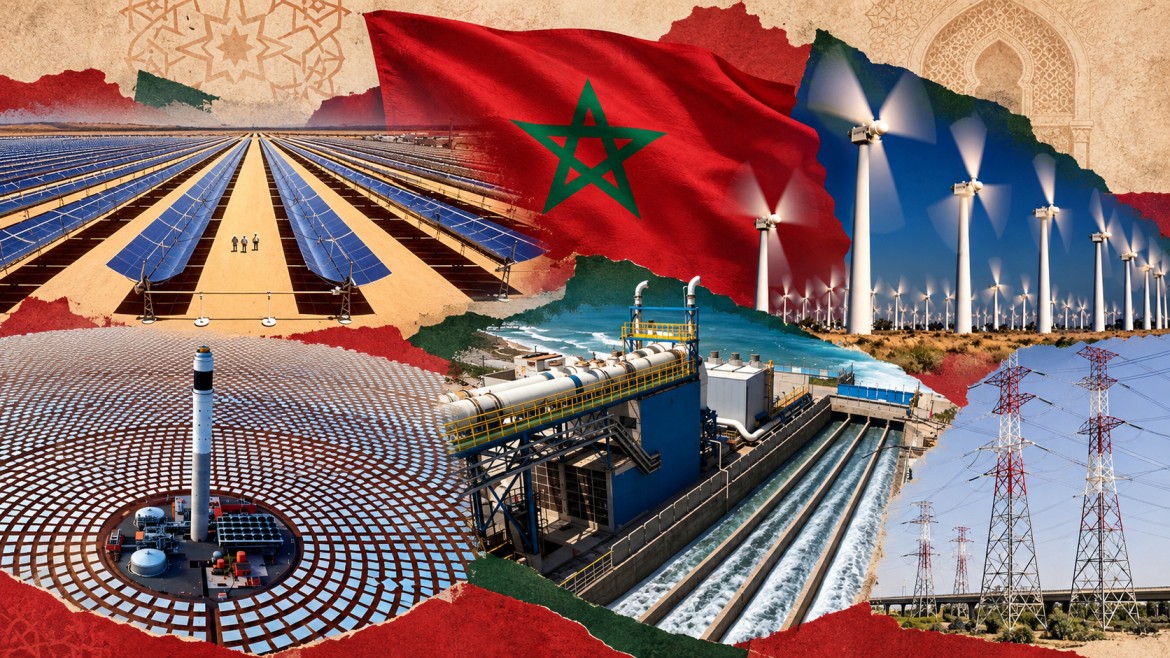
Morocco needs a lot more money to finance its green transition. Solar and wind farms, desalination plants, power networks, energy-efficiency projects and cleaner industries all need large amounts of capital before they can be built. The finance ministry estimates that the latest climate plan will require $96bn in investment by 2035.
The plan, submitted in September 2025, targets a 53% reduction in greenhouse-gas emissions. It includes 80 sectoral objectives and 107 major projects.
The figure is higher than an earlier World Bank estimate. The bank put the investment needed between 2022 and 2050 at about $78bn to put Morocco on a resilient, low-carbon path.
That estimate included measures to deal with water shortages, protect against floods and cut emissions across the economy.
Public money cannot cover the full cost. Private investors will need to provide a much larger share of the funding.
The government adopted a Climate Finance Development Strategy in September 2024. The strategy aims to raise 50% of the resources needed from the private sector.
That puts banks in a key position.
Most businesses, especially small and medium-sized enterprises (SMEs), still rely on bank loans to finance investments. The challenge is to make green lending part of normal banking rather than something limited to specialist products.
International financial institutions are already using Moroccan banks to move climate finance into the economy.
In February 2024, the International Finance Corporation (IFC) provided $100m, worth about 1bn dirhams at the time, to Crédit du Maroc.
The money is meant to support SMEs, women entrepreneurs and green investments. These include energy efficiency, renewable energy, green buildings and agriculture that can better deal with climate risks.
The European Bank for Reconstruction and Development (EBRD) has built similar programmes with local banks.
In 2025, the EBRD and its partners announced up to €50m in green financing for Crédit du Maroc.
The first part, worth up to €25m, targets SMEs. It can finance solar power, energy and water efficiency, greener buildings and the circular economy. EU-funded grants will also help businesses buy green technologies.
Another €25m can go to medium-sized and larger companies. It covers renewable energy, industrial energy efficiency and sustainable construction. It also supports climate-adaptation projects such as wastewater treatment and desalination.
The EBRD and its partners have also announced up to €65m in green financing for BMCI.
Saham Bank has received a package worth up to €55m. The money will be used to provide loans to SMEs, medium-sized businesses and large companies for green investments.
This system gives international lenders a way to reach many businesses through local banks.
A small factory does not need to build a wind farm to take part in the green transition. It may install solar panels on its roof, replace an old machine that uses too much electricity, cut water use or change part of its production process to reduce emissions.
These projects can still be difficult to finance.
A company has to pay for new equipment immediately, while the savings may come over several years. A suitable loan, a guarantee or an investment grant can make the difference.
Some programmes therefore combine bank loans with cheaper international funding, technical support and grants.
Banks are not the only source of finance.
Large infrastructure projects need long-term money, which can come from insurance companies, pension funds, investment funds and other institutional investors.
Green bonds offer another way to raise this money. An issuer sells bonds and commits to using the money for projects with defined environmental benefits.
The Moroccan Capital Market Authority (AMMC) has developed rules for this market. It first worked on green bonds and later published guidance covering green, social and sustainable bonds.
The rules require issuers to use the money for eligible projects and provide indicators showing their environmental or social impact.
This can give companies and institutions another option when bank loans are not enough.
The government is also preparing new tools.
The finance ministry said in April 2026 that work was continuing on a framework for issuing a sovereign sustainable bond. The work also covers climate labelling for the state budget and greener public procurement.
Another major issue is deciding what counts as a green investment.
Banks and investors need common rules to know whether a project is genuinely aligned with environmental goals. A lack of common definitions and reliable data has been a problem for the growth of climate finance.
A green financial taxonomy is being developed to address this.
The taxonomy is designed to give banks, investors, companies and regulators a common way to classify economic activities according to their environmental impact.
The government launched a public consultation on the draft taxonomy in July 2026.
The finance ministry, Bank Al-Maghrib, AMMC, the insurance and pensions regulator ACAPS, and the Ministry of Energy Transition and Sustainable Development are involved in the work.
The World Bank and Expertise France are providing technical support.
A common system should make it easier for investors to compare projects, understand where their money is going and avoid different institutions using different definitions of “green”.
International lenders remain important because they can offer long-term loans, guarantees, technical assistance and cheaper financing.
The World Bank announced a $400m programme in June 2026 to help finance climate risks.
The programme includes a facility to prepare projects before they seek investment. It will help develop a pipeline of commercially viable projects in renewable energy, energy efficiency, sustainable transport and water infrastructure.
The programme also uses blended finance and market instruments to reduce risks for private investors.
The World Bank aims to mobilise up to $400m in private capital over five years.
The basic problem is simple: money available in the financial system does not automatically become money for green projects.
A project needs to be properly prepared. It needs a clear business model. Its risks also need to be acceptable to banks and investors.
Blended finance can help.
Public or international money can take on part of the risk or improve the financial terms. Private investors can then be more willing to provide the rest.
This matters particularly for projects that are new, complex or difficult to make profitable under normal market conditions.
The financial system is therefore becoming an important part of climate policy.
Bank Al-Maghrib, AMMC, ACAPS, commercial banks, institutional investors and international lenders all have a role alongside the ministries responsible for energy, water and industry.
The official assessment behind the 2030 climate-finance strategy found that Morocco already has a relatively broad range of green-finance tools. It also found a gap between the supply of finance and demand for it.
Large companies and major infrastructure projects have more financing options. They can combine bank loans, international funding, partnerships, bonds and equity.
SMEs face more limits.
Their size often prevents them from raising money directly on capital markets or dealing with major international lenders. They depend more on banks, guarantees, international credit lines distributed through local banks and investment grants.
The issue matters beyond climate targets.
A company that uses less electricity or water can also reduce its production costs. Cleaner production can also become more important for exporters as environmental requirements increase in some overseas markets.
Green finance therefore has to reach both ends of the economy.
Large solar and wind projects need billions of dollars. Smaller companies need access to affordable finance to replace equipment, install solar panels, reduce water use or make production cleaner.
The scale of the challenge is clear. The latest climate plan requires about $96bn by 2035, while public funding still makes up most climate-finance flows.
The task now is to bring much more private money into the system.
Banks can provide loans to businesses. International lenders can provide cheaper finance, guarantees and technical support. Investors can provide long-term capital through bonds and other instruments. The green taxonomy can provide common rules.
All these parts need to work together.
The success of the green transition will depend not only on building new infrastructure, but also on whether the financial system can provide enough money, for enough businesses and for long enough.