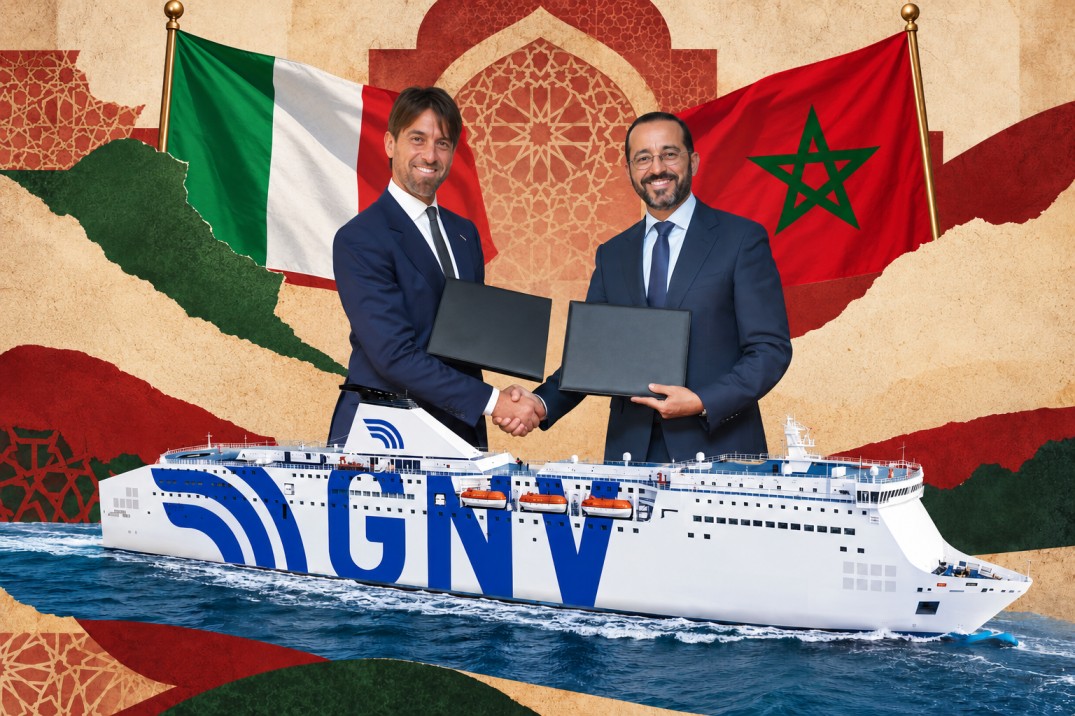
Morocco wants to bring more Italian tourists by ferry. The Moroccan National Tourism Office (ONMT) and Italian ferry company Grandi Navi Veloci (GNV) have signed a three-year agreement to increase passenger capacity and promote travel between Italy and Morocco. The deal was finalised in Rabat after GNV held its annual convention in Marrakech. It combines more ferry capacity with a joint tourism campaign across Italy.
The two organisations want to increase passenger capacity for Italian travellers to 350,000.
Italy is an important tourism market. Some 1.15 million Italian tourists visited Morocco in 2025. About 15% of them, or roughly 172,500 people, arrived by sea.
The new campaign will promote Morocco across Italy through television, radio, influencers, street marketing and travel agencies. GNV will also promote Moroccan tourism on its ships through digital screens, onboard radio and the GNV APP Maroc.
The campaign will focus on Italian travellers interested in eco-tourism, road trips and 4×4 trips. Ferries give these travellers an option that planes cannot: they can take their own cars with them. This makes it easier to visit several parts of the country during one trip.
The plan also supports Operation Marhaba, the annual summer operation that helps millions of Moroccans living abroad travel between Europe and Morocco. Italy is one of the main European countries involved in this seasonal movement.
GNV has operated ferry links with Morocco for more than 20 years. Its main routes include Genoa-Tangier Med, Civitavecchia-Tangier Med and Barcelona-Tangier Med.
The company carried more than 465,000 passengers on its Moroccan routes in 2025.
The new agreement comes as GNV is investing heavily in its fleet. The company has a €1.3bn fleet renewal programme running until 2030. It is the biggest fleet investment programme in GNV’s history.
Two new LNG-powered ships, GNV Aurora and GNV Virgo, are at the centre of the programme. Guangzhou Shipyard International in China built both vessels.
Each ship is 218 metres long and 29.6 metres wide. Each has a gross tonnage of 52,300 GT and can reach 25 knots, or about 46km/h.
Each vessel can carry 1,785 passengers in about 426 cabins. Both use dual-fuel LNG engines and have cold-ironing systems, which allow them to connect to electricity from the shore while in port and switch off their onboard generators.
GNV Aurora is dedicated to routes serving Morocco. The ship was christened on 1 June 2026 at Tangier City Port.
The LNG ships are also designed to meet stricter European maritime emissions rules, including the EU Emissions Trading System and FuelEU Maritime standards.
Compared with traditional heavy fuel oil, LNG can cut sulphur oxide and particulate emissions by more than 95%. It can reduce nitrogen oxide emissions by up to 85%. Direct carbon dioxide emissions can fall by around 20-25%.
LNG is not a zero-carbon fuel, however. Its overall climate benefit also depends on methane leakage during fuel production and transport.
The new ships also have larger passenger and vehicle capacity. That is important during Operation Marhaba, when more than 3 million Moroccans living abroad can travel through the country’s ports during the summer period.
The ferry network therefore serves both tourism and family travel.
The new target of 350,000 Italian passengers is significant. Around 172,500 Italian visitors arrived by sea in 2025. Reaching the new capacity would mean almost doubling the current number of sea-based Italian visitors if the available capacity is fully used.
The agreement also gives ONMT another way to promote travel outside the main tourist centres. Travellers with their own vehicles can move between different regions and take part in road trips, 4×4 tours and eco-tourism activities.
GNV is part of the MSC Group and operates passenger and vehicle ferry services across the Mediterranean, including Italy, Spain, France, Albania, Tunisia and Morocco.