

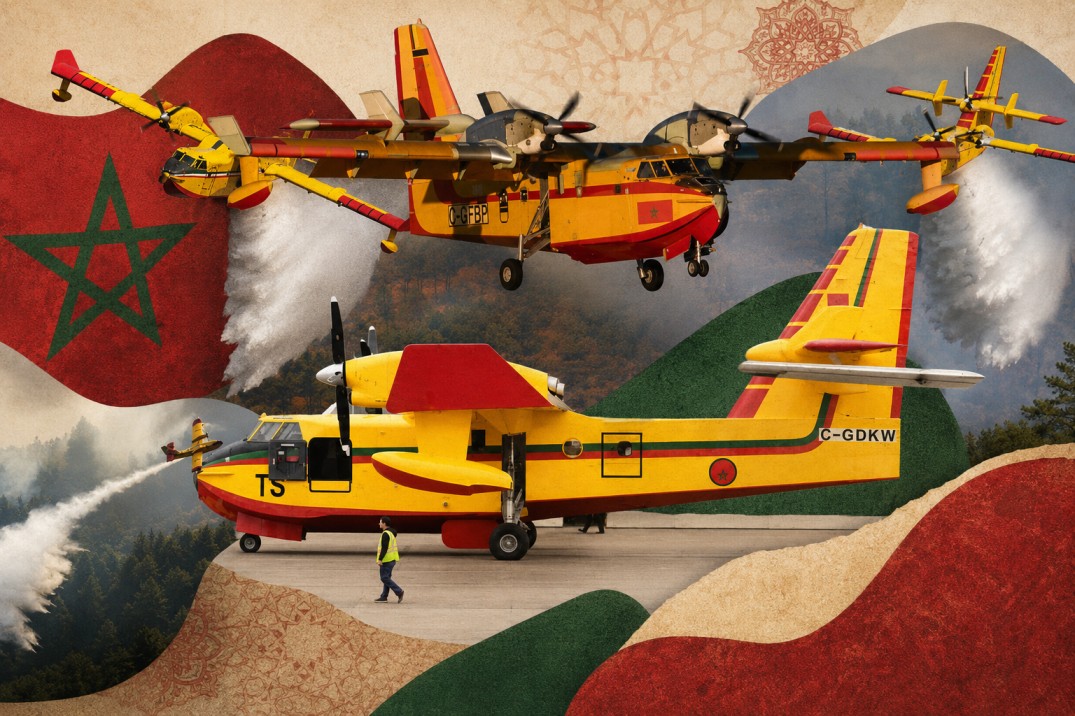
Wildfires are becoming more common as climate change pushes temperatures higher. Morocco is one of the few countries with a large fleet of aircraft built to fight them. The country operates eight Canadair CL-415 water bombers. That is the fifth-largest fleet in the world, behind Italy and Spain, which each have 18 aircraft, Greece with 17 and France with 12. It is also the largest fleet in Africa and the Arab world.
The aircraft help tackle fires that break out every summer, especially in the Rif Mountains and other northern areas. Chefchaouen, Larache, Taounate, Taza and Al Hoceïma are among the provinces most exposed during heatwaves.
The CL-415, often called the “Super Scooper”, is built for aerial firefighting. It can scoop up 6,137 litres of water from the sea, a lake or a reservoir in just 12 seconds while skimming the surface at 130km/h. The aircraft needs at least two metres of water depth and a clear 410-metre stretch to refill.
Each aircraft is powered by two Pratt & Whitney Canada PW123AF turboprop engines producing 2,380 shaft horsepower each. It has a top speed of 333km/h and can make up to nine water drops an hour when a water source is within 10km of a fire. A 300-litre foam system can mix firefighting foam with water to make each drop more effective.
The heavy fleet includes five standard CL-415 aircraft and three upgraded CL-415EAF models. The newer aircraft are converted CL-215 airframes fitted with new engines, digital glass cockpits and corrosion-resistant materials.
Together, the eight aircraft can drop more than 35,000 litres of water in a single pass.
Heavy water bombers are backed by eight Ayres 710P Turbo Thrush aircraft operated by the Royal Gendarmerie. Originally built for crop spraying, they have been converted for firefighting and can carry about 2,687 litres of water or fire retardant. Their smaller size allows them to fly into narrow valleys and steep mountain terrain where larger aircraft cannot operate safely.
Most of the Canadair fleet is based at the Third Royal Moroccan Air Force Base in Kenitra. The location gives crews quick access to northern fire zones as well as the Atlantic coast and major reservoirs. The Turbo Thrush aircraft operate mainly from Salé Air Base.
Water is collected from the Mediterranean, the Atlantic Ocean and reservoirs such as El Wahda Dam and Idriss I Dam. Freshwater reservoirs are often preferred because they reduce corrosion compared with seawater.
A joint command system brings together the Royal Moroccan Air Force, the Royal Gendarmerie, Civil Protection and the National Agency for Water and Forests (ANEF). Satellite imagery, drones and ground teams detect fires before aircraft are sent to the scene.
Aircraft usually arrive first to slow the fire while firefighters move into position on the ground. The planes then keep flying repeated water runs until the blaze is under control.
Large firefighting aircraft have become difficult to buy. Production of the CL-415 stopped for several years before De Havilland Canada restarted the programme with the updated DHC-515 First Responder. Strong demand from Europe and North America means new aircraft now have delivery times of four to six years.
That gives countries with existing fleets an important advantage.
The fleet was built in two phases. Five new CL-415 aircraft were bought from Bombardier between 2011 and 2013 for an estimated $162 million to $175 million. Three upgraded CL-415EAF aircraft were added between 2022 and 2024 under a 1.2 billion dirham contract, worth about $115 million to $120 million.
Total investment in the eight heavy water bombers is estimated at between $280 million and $300 million, excluding maintenance, pilot training and air base infrastructure.


