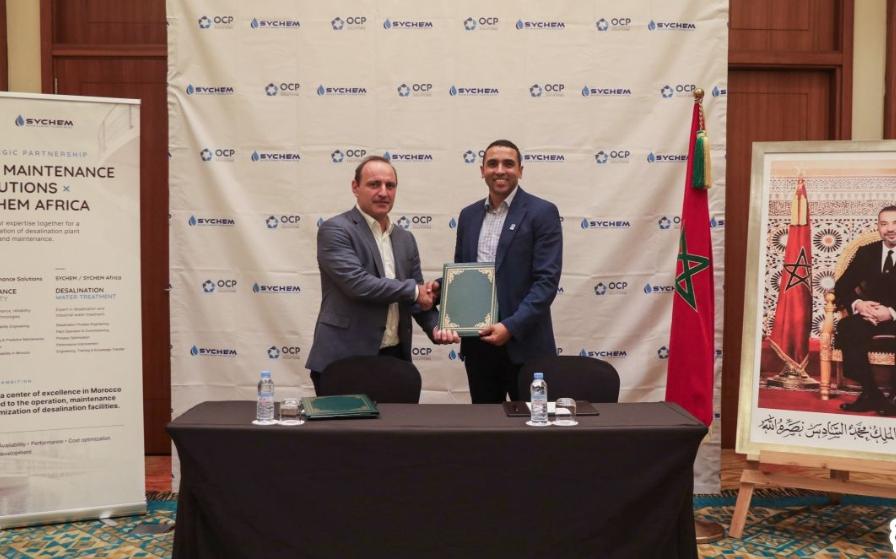
Phosphate group OCP is working with Greek engineering company Sychem to help keep desalination plants running efficiently and reduce maintenance costs. OCP Maintenance Solutions (OMS), a subsidiary of OCP Group, through Sychem’s Moroccan subsidiary, Sychem Africa. The agreement sets out an initial 12-month cooperation period and plans for a specialist centre in Morocco to support the operation and maintenance of desalination plants.
The companies aim to improve equipment reliability, detect faults before they cause breakdowns and control operating costs. They have not disclosed which plants will be covered, the financial value of the agreement or how much additional water the partnership could produce.
The deal follows an initial announcement in El Jadida in September.
The first phase will assess how reliably equipment operates, how quickly maintenance teams respond to problems and how much it costs to run the facilities. The locations and capacities of the plants involved have not been specified.
OMS will provide local technical teams, industrial equipment management and digital monitoring systems. These systems analyse data from machinery to identify early signs of failure and allow maintenance to be scheduled before equipment breaks down.
Sychem will contribute its experience in designing, manufacturing and operating seawater desalination plants, including engineering and process management.
Its specialists will help commission facilities, train staff and transfer technical know-how to Moroccan teams. The companies also plan to recruit Moroccan engineers and technicians, depending on the availability of suitably qualified workers.
The agreement includes a commercial arrangement under which each company can offer the other’s services to its own customers. Sychem will be able to market OMS’s maintenance and monitoring systems, while OMS can offer Sychem’s engineering and desalination services to its industrial clients.
The results of the first 12 months will help determine whether the cooperation should be extended to other facilities.
The two companies also plan to establish a centre of expertise dedicated to desalination plant operations and maintenance.
OMS said it intended to “build a centre of excellence in Morocco and support new projects in Africa and internationally”.
The proposed centre is expected to bring together technical skills for maintaining and operating desalination facilities. However, no location, opening date, staffing plan or financing details have been announced.
The companies could eventually extend their cooperation to other projects in Morocco, Africa and international markets. No additional plant orders or overseas contracts have been announced.
Sychem already has links with OCP through its work on the group’s water infrastructure.
In 2024, Sychem chairman and chief executive Alexandros Yfantis highlighted the company’s role as a technology partner in OCP Green Water’s Wave 2E project at Jorf Lasfar.
The facility can desalinate 60,000 cubic metres of water a day — equivalent to 60 million litres — to help meet the water needs of OCP’s industrial operations.
OCP Green Water, established in 2022, manages desalination plants and wastewater recycling networks serving the group’s industrial sites and nearby municipalities, including areas around Jorf Lasfar and Safi.
By mid-2026, the company’s operational desalination capacity had reached about 340 million cubic metres a year across eight main coastal facilities, according to the figures provided.
OCP aims to increase that capacity to between 560 million and 630 million cubic metres a year by 2027-30. Its wider green investment plan has allocated more than $600m to water infrastructure.
The group said it had reached 100% reliance on non-conventional water across its industrial operations by early 2025. That means its sites use desalinated seawater and treated wastewater rather than relying on conventional freshwater sources.
The partnership comes as Morocco faces prolonged drought and growing pressure on its water supplies. The country has endured six consecutive years of severe drought, prompting efforts to expand desalination and wastewater treatment.
Desalination plants that use reverse osmosis push seawater through special membranes to remove salt. The process can be expensive, and equipment such as high-pressure pumps and membranes can wear out or become less efficient over time.
Predictive maintenance uses equipment data, including information on vibration and temperature, to spot potential problems early. The approach can help reduce unexpected shutdowns, energy use and repair costs, although the benefits of this particular partnership have yet to be measured.
Important details remain unresolved. The companies have not disclosed the agreement’s investment costs, operating budgets, revenue-sharing arrangements or specific performance targets.
Expanding the partnership into other African markets will also depend on securing project financing, reliable customers and agreements to buy the water produced.
The initial 12-month period will therefore be an important test of whether the companies can improve plant performance and develop a joint business beyond their existing work with OCP.