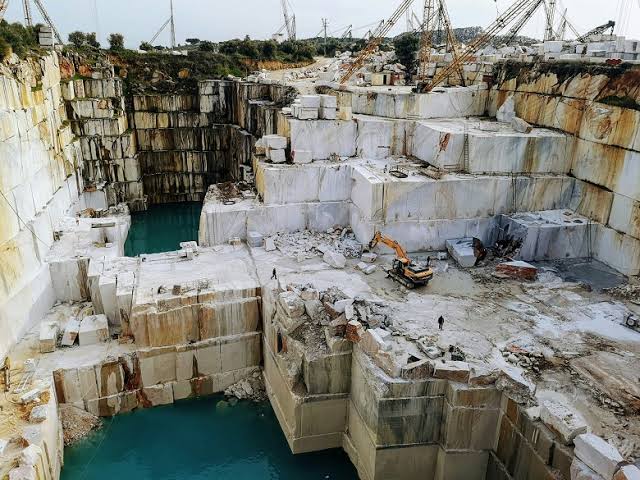
Portuguese natural stone exports to Morocco reached €1.68m between January and July, up 14.74% from a year earlier, even though the amount of stone shipped fell by almost 14%. Data from the Portuguese Association of the Mineral Resources Industry (Assimagra) shows that 4,266 tonnes were shipped to Morocco during the period, down 13.91% from the same period in 2025.
The average price rose sharply to €393 per tonne, compared with €295 a year earlier. That was a 33.27% increase.
Only Canada, with a 269.40% increase, Poland, with 36.07%, and Denmark, with 33.70%, recorded larger increases among Portugal’s top 30 export markets.
Morocco accounted for 0.62% of Portugal’s total natural stone sales and ranked as the sector’s 24th-largest market.
The figures cover both raw and processed natural stone, including slate, marble, travertine, granite, porphyry, basalt, sandstone, limestone, kerbs, flagstones, building stone, cubes, pellets and worked slate.
The higher price per tonne points to stronger sales of more expensive stone products, even as total volumes fell. Demand is being supported by construction, hotels, tourism projects and large infrastructure developments linked to preparations for the 2030 Fifa World Cup.
Morocco is also targeting 26 million tourists by 2030. That expansion is creating demand for materials used in hotels, high-end homes, public spaces and transport projects.
The wider Portuguese stone industry is facing a weaker year.
Total exports reached €271.7m in the first seven months, down 4.65% from a year earlier. Export volumes fell 5.04% to 983,246 tonnes, while the average price increased slightly by 0.41% to €276 per tonne.
Portuguese stone reached 114 markets. The European Union accounted for 53% of total export value.
France remained the largest market, with sales of €55.19m, down 16.92%, a fall of €11.24m.
China followed with €38.70m, up 0.56%, while Spain reached €37.79m, up 12.61%. The United States recorded €21.18m, down 12.15%, and the United Kingdom reached €16.63m, up 12%.
Germany bought €12.92m, down 5.15%, while India recorded €11.50m, up 58%.
The US paid the highest average price among the main markets, at €1,405 per tonne. France paid €285 and China €142. China was the largest buyer by volume, taking 272,681 tonnes.
The decline in Portuguese exports was driven mainly by weaker sales inside the European Union. Sales to the 27 EU countries fell 7.48% to €143.89m.
Sales to countries outside the EU fell by only 1.24%, reaching €127.77m.
Purchases from Opec countries fell 23.54% to €12.96m. Sales to Portuguese-speaking African countries fell by 50% to €1.84m. Efta countries recorded a smaller decline of 0.57%, reaching €5.84m.
Limestone was the biggest seller, generating €76.94m, or about 28% of total exports. Granite followed with €72.44m, or 27%, and marble with €62.17m, or 23%.
Porphyry and basalt generated €11.14m, while schist brought in €4.07m. A further €44.90m was not classified by material.
Processed stone made up most granite sales, generating €57.54m compared with €14.90m from extraction. Processed limestone generated €48.32m, compared with €28.62m from raw limestone.
Marble sales were more evenly split, with €32.84m from extraction and €29.32m from processing.
July was the strongest month of the year, with €47.73m in exports, slightly above the €47.11m recorded in July 2025.
Even so, sales from January to July were the lowest since 2021. They remained well below the €309.5m recorded during the same period in 2023, €298m in 2022, €289.3m in 2024 and €284.9m in 2025.
The industry is trying to offset weaker European demand by targeting higher-value products and new markets.
Assimagra took Portuguese stone companies to the Marmomac 2026 trade fair in Verona, Italy, in late September. The sector used the event to promote high-end technical design, more sustainable production and new international partnerships.
Portuguese companies are also using programmes such as Compete 2030 and Interstone to modernise extraction sites, reduce environmental impact and increase the share of processed stone in exports.
The shift is important because processed stone generally brings higher prices than raw blocks. The figures from Morocco show that a smaller volume can still produce higher export earnings when buyers move towards more expensive products.