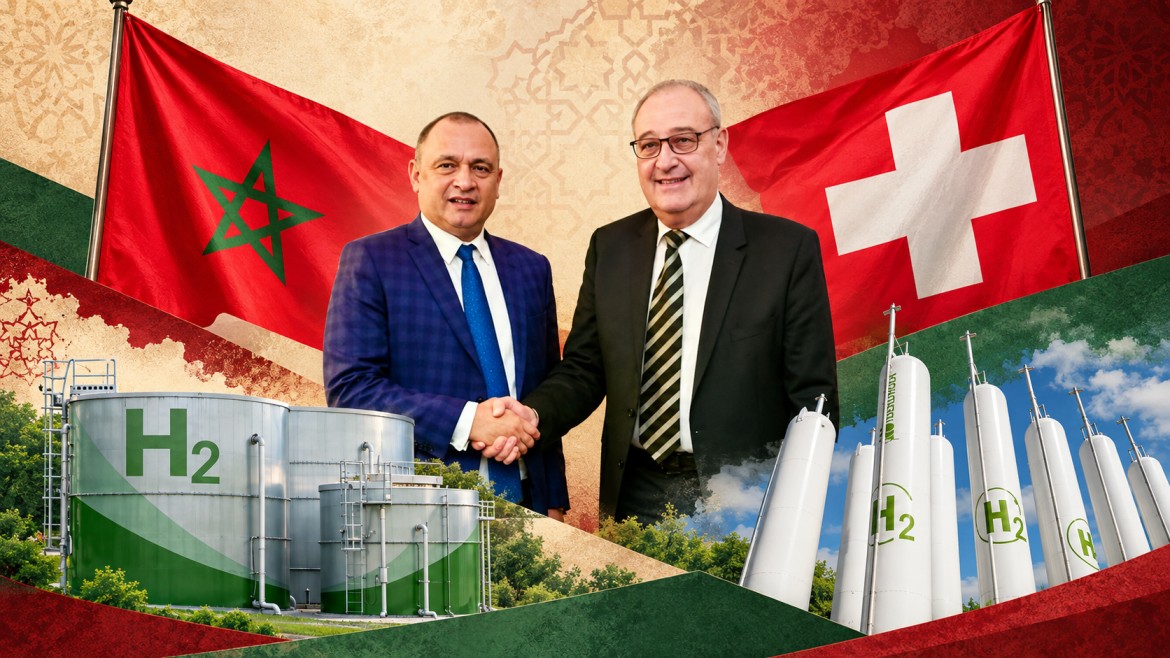
Switzerland has put Morocco at the top of its list of countries for possible cooperation on renewable hydrogen and related fuels. The Swiss Federal Council approved a report on 25 September looking at how Switzerland could support investments in renewable energy production sites abroad and how these projects could help the country’s long-term energy security.
The report identifies four emerging economies for possible cooperation: South Africa, Indonesia, Morocco and Vietnam. Morocco receives a separate and more positive assessment.
“Because of its geographical proximity to Europe, Morocco appears to be the most interesting country for possible cooperation […] in the field of renewable synthetic energy carriers,” the Federal Council said.
Several factors support the choice. Morocco has strong solar and wind resources, experience with large solar projects and an established industrial base. The country also has a national strategy covering the full hydrogen chain, from renewable electricity production to the sale of hydrogen and related products abroad.
The report also points to problems. Water shortages in southern Morocco and some infrastructure gaps could affect future projects.
“Morocco nevertheless offers good conditions, particularly for cooperation with Swiss universities and companies,” the report said.
The report suggests possible joint work between Switzerland’s federal institutes of technology, universities of applied sciences and companies and institutions in Morocco. The work could focus on training, technology transfers and studies needed before industrial projects are launched.
“Morocco would be a priority. The feasibility and interest of the Moroccan partners remain to be confirmed,” the report said.
The Swiss government already has a legal basis for some cooperation with Morocco. The two countries signed a bilateral agreement in November 2022 on the implementation of the Paris Agreement. Under certain conditions, the agreement allows Switzerland to count emissions reductions achieved outside the country.
Switzerland is not creating new public funding for Morocco at this stage.
The Federal Council has ruled out, for now, a dedicated climate fund and a state guarantee for investment risks. The report says a lack of financial resources is the main reason.
Swiss international cooperation currently does not finance any projects focused on renewable hydrogen derivatives. Other guarantee mechanisms linked to climate finance are still being considered.
The Swiss Federal Office of Energy will also follow developments through its monitoring of the national hydrogen strategy.
The report says hydrogen and synthetic fuels could be useful for some industries and forms of transport that are difficult to electrify. These include aviation and shipping. Their direct contribution to Switzerland’s energy security is expected to remain limited, apart from synthetic fuels for aviation.
Swiss companies have already started working on projects in Morocco.
Swiss company Synhelion signed a memorandum of understanding with the Moroccan government on 8 September to build a renewable synthetic-fuel plant in Tan-Tan. The planned facility would have a production capacity of 100,000 tonnes a year.
A site has already been reserved and Synhelion has set up a local subsidiary, Synhelion Maroc. The company has not disclosed the investment amount or construction timetable.
The framework for such projects was set out in March 2024 through the Green Hydrogen Offer. It covers the full chain, from renewable electricity production to converting hydrogen into ammonia, methanol and synthetic fuels.
The Swiss report does not announce a new agreement with Morocco or guarantee government funding. It sets out a preference for Morocco among possible partner countries.
“Knowledge transfer between universities, universities of applied sciences and Swiss companies and partner institutions in priority countries […] is supported through international cooperation. Preliminary project studies could also be considered. Morocco would currently be the preferred partner country,” the report said.
Switzerland plans to review its support tools as the Swiss hydrogen market develops.