
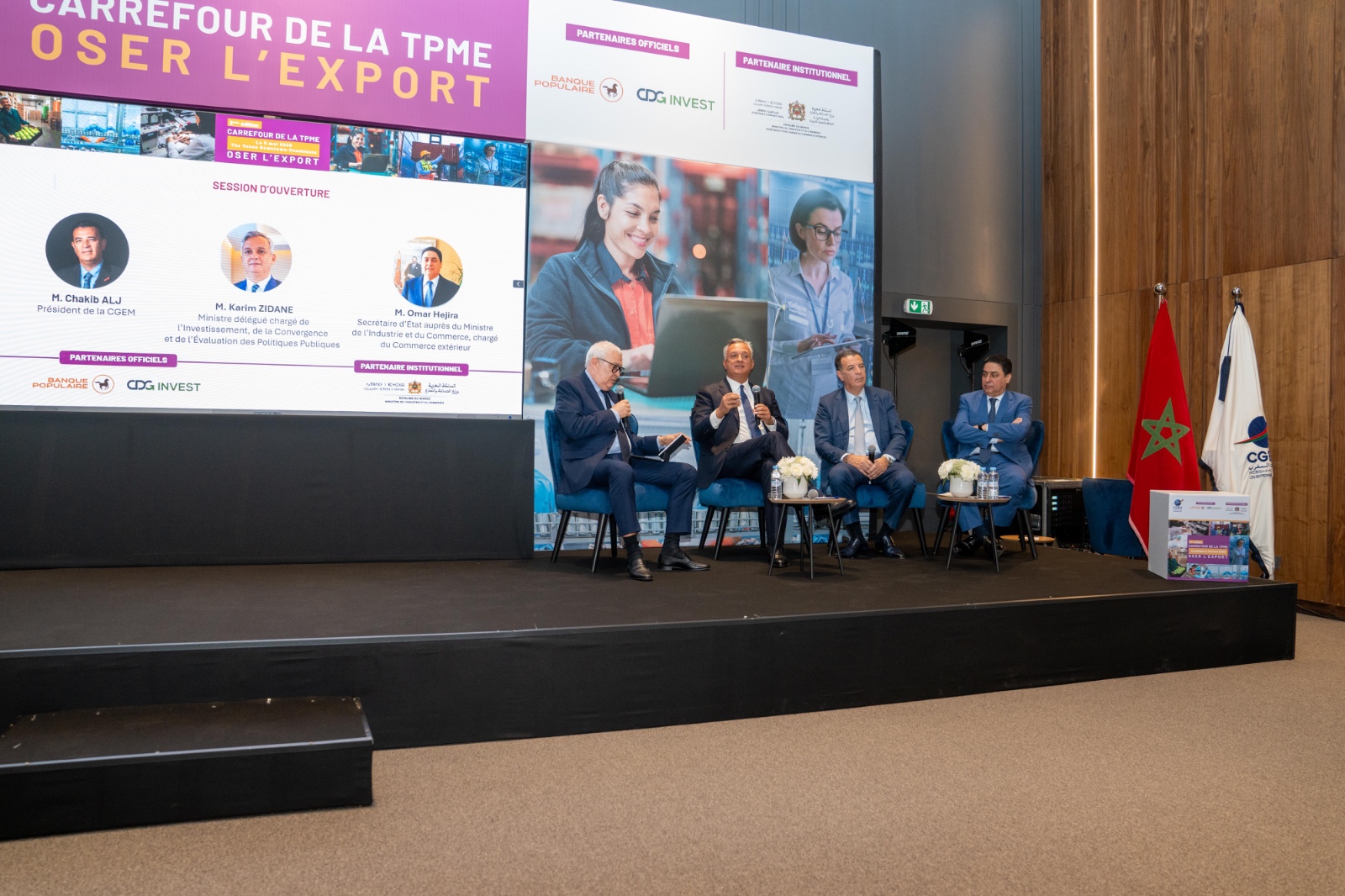
For many small business owners in Morocco, selling abroad still feels out of reach. At a major gathering in Casablanca, officials and business leaders urged them to change that mindset and start exporting.
The General Confederation of Moroccan Enterprises held the second Carrefour de la TPME on Tuesday under the theme “Dare to Export”. The event brought together public officials, experts and entrepreneurs to help small and medium enterprises enter global value chains.
Karim Zidane, Minister Delegate for Investment, and Omar Hejira, Secretary of State for Foreign Trade, said SMEs are the backbone of the economy. They said structured support is needed to help these companies succeed overseas.
CGEM president Chakib Alj said only 6,000 Moroccan companies export today and called the figure far below potential.
“A company does not become competitive before exporting, but rather by exporting,” he said. “The real challenge is not just to export more, but above all to get a larger number of companies to export. Why not aim to double this number in the short term?”
He said global markets should not be seen as the preserve of big firms. “In reality, the first barrier to exporting is neither technical nor regulatory: it is often mental. The international market must become a reflex, especially for small businesses.”
Entrepreneurs including Anwar Radi of ENOSIS Group and Ghalia Sebti of AIT MANOS shared how they expanded beyond Morocco. Experts from Maroc PME, AMDIE and the BCP Group discussed market entry strategies and financing options. A workshop looked at how artificial intelligence can support international growth.
The summit comes as Morocco pushes to widen its base of exporters and position itself as a hub for green energy and high-tech manufacturing.
Days earlier, the Morocco SME Agency launched the PACTE TPME 2026–2030 programme. It aims to help very small, small and medium businesses grow with technical expertise and digital management tools. The goal is to help small workshops become modern factories able to supply global companies such as Boeing and Stellantis.
Morocco’s economy is expected to grow by 3.9% in 2026, above global averages. Automotive exports rose by more than 6% in 2024 to nearly MAD 158bn. New trade openings have also emerged after China removed tariffs on African goods.
Challenges remain. A 2025 survey found half of Moroccan small businesses struggle to access bank loans because of high collateral demands and complex procedures. Around 77% do not accept digital payments. New international rules, including European carbon border measures, are also pushing exporters to adopt greener production.