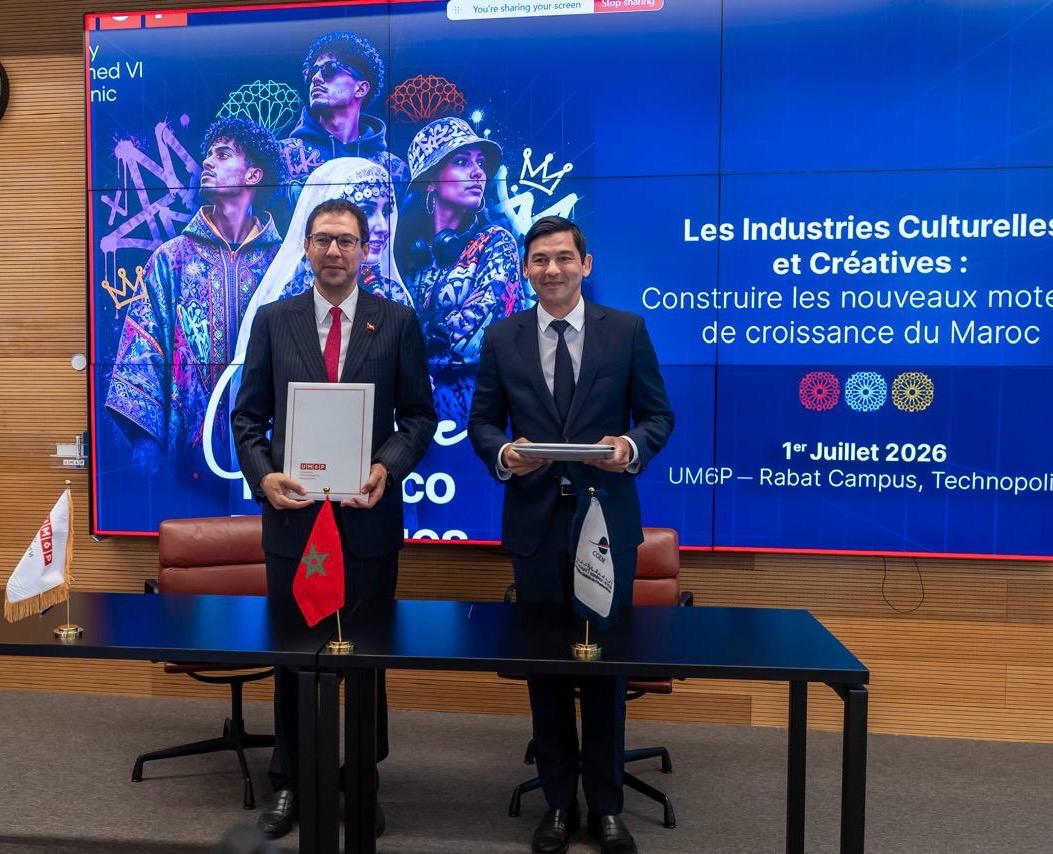
Morocco wants to turn its creative industries into a bigger source of jobs, investment and economic growth. Government officials, business leaders, artists, researchers and investors met in Rabat on Tuesday for the first Creative Morocco Dialogues to discuss how to help the sector grow. The event was organised by Mohammed VI Polytechnic University (UM6P) and the Federation of Cultural and Creative Industries (FICC) with support from the International Finance Corporation (IFC) and UNESCO.
The meeting also saw UM6P and the FICC sign a partnership agreement to bring universities and creative businesses closer together. They will work on skills training, research, data and public policy.
New figures shared at the event show the sector is already making an important contribution to Morocco’s economy.
According to the IFC, cultural and creative industries contribute about 2.4% of Morocco’s GDP. They generated MAD 43 billion ($4.7 billion) in revenue last year, up 18% from the previous year.
The sector employs more than 116,000 people, equal to about 1% of Morocco’s workforce. Women make up 34% of these jobs, compared with 21% across the national workforce.
Creative industries also create 3.7 jobs for every MAD 1 million of value added, compared with 3.2 jobs in manufacturing.
Morocco has nearly 9,500 registered creative companies, most of them small businesses. Traditional crafts, heritage and cultural tourism bring in the most revenue, followed by festivals, performing arts and audiovisual production.
A big part of the discussions focused on artificial intelligence. Participants said AI can help creative businesses grow, but only if it is built using data that reflects Morocco’s culture, languages and history.
Officials also said the 2030 FIFA World Cup, which Morocco will host with Spain and Portugal, is a chance to promote Moroccan culture, design and digital content to a global audience.
The discussions come two months after Morocco’s Ministry of Youth, Culture and Communication launched three joint programmes with the European Union, the Hiba Foundation, Africalia and the Goethe-Institut to support young creative entrepreneurs and regional digital projects.
Despite its growth, the sector still struggles to secure funding. Creative businesses receive less than 0.5% of corporate bank lending in Morocco.
The ideas discussed at the forum will now be brought together in a White Paper with recommendations on how to attract more investment and make creative industries a bigger part of Morocco’s economic future.