
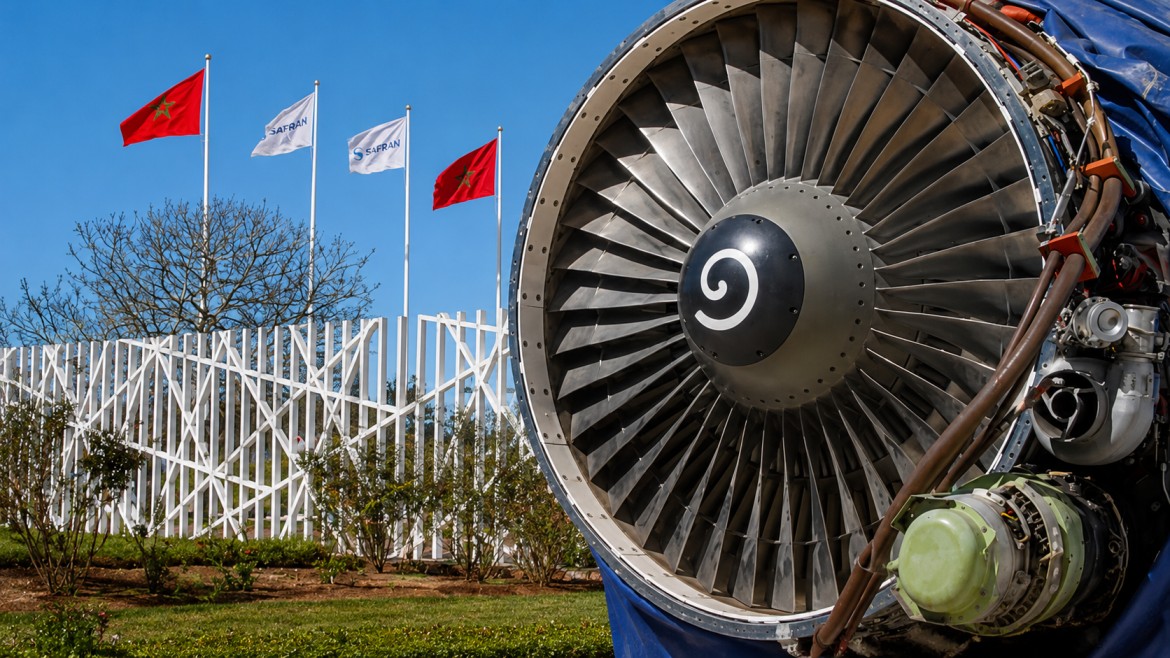
Morocco wants to double its aerospace exports to 56 billion dirhams ($6 billion) by 2030 as it expands from making aircraft parts to producing more advanced technologies, including aircraft engines.
Speaking at an event hosted by the Policy Center for the New South, Midparc Chairman Hamid Benbrahim El Andaloussi said Morocco’s aerospace industry has changed dramatically over the past 25 years.
“Twenty-five years ago, Morocco was not even considered a potential destination for the aerospace industry. Today, it has become an industrial hub hosting 155 companies and providing more than 27,000 jobs.”
He said the industry started in the early 2000s by producing electrical systems and aircraft wiring. Since then, it has moved into high-precision machining, composite materials, 3D printing, electronics, landing gear systems, research and development, and aircraft engine manufacturing.
“Manufacturing aircraft engines represents the core of aerospace technology, accounting for more than 50% of the technology used in an aircraft, and serves as the hub for future innovations in the sector.”
Morocco’s aerospace exports are now worth around 28 billion dirhams ($3 billion). The sector has also reached a 40% local integration rate, meaning 40% of the value of its aerospace products is made inside Morocco. That is up from less than 10% two decades ago.
El Andaloussi said the next goal is to keep the industry growing by around 15% each year, allowing exports to reach 56 billion dirhams ($6 billion) by 2030. Morocco also wants to increase the local integration rate to more than 45%.
He said Morocco has attracted investment because it is close to Europe, where some traditional manufacturing sites have become less competitive.
“The competitiveness of several traditional industrial sites within Europe has declined, helping the Kingdom attract new investments in the aerospace industry.”
He also said skilled workers have been one of the biggest reasons behind the industry’s success.
“Training human talent has been a decisive factor in the sector’s success given the strict quality and safety standards required by the aerospace industry. Morocco has proven its ability to meet its commitments and provide world-class skills.”
Morocco has become one of Africa’s biggest aerospace manufacturing hubs. Midparc, an aerospace industrial zone near Casablanca, is home to global companies including Boeing, Safran, and Bombardier.
The country is also moving into more advanced engine production. Safran Aircraft Engines operates a maintenance, repair and overhaul centre in Casablanca for the CFM56, the world’s best-selling commercial aircraft engine. Morocco is also making parts for the newer LEAP engine, which requires advanced manufacturing techniques.
The industry has benefited from a growing trend known as nearshoring, with European companies moving production closer to home to make supply chains shorter and more reliable. Morocco’s location, lower labour costs, political stability and free trade agreements with the European Union and the United States have helped attract investment.
Training has also supported the sector’s growth. The Institute of Aeronautical Professions (IMA) in Casablanca works with the government and the Moroccan Aerospace Industries Association (GIMAS) to train workers with the technical skills aerospace companies need.
Morocco is also looking to grow its defence aerospace industry, including drone assembly and maintenance.