
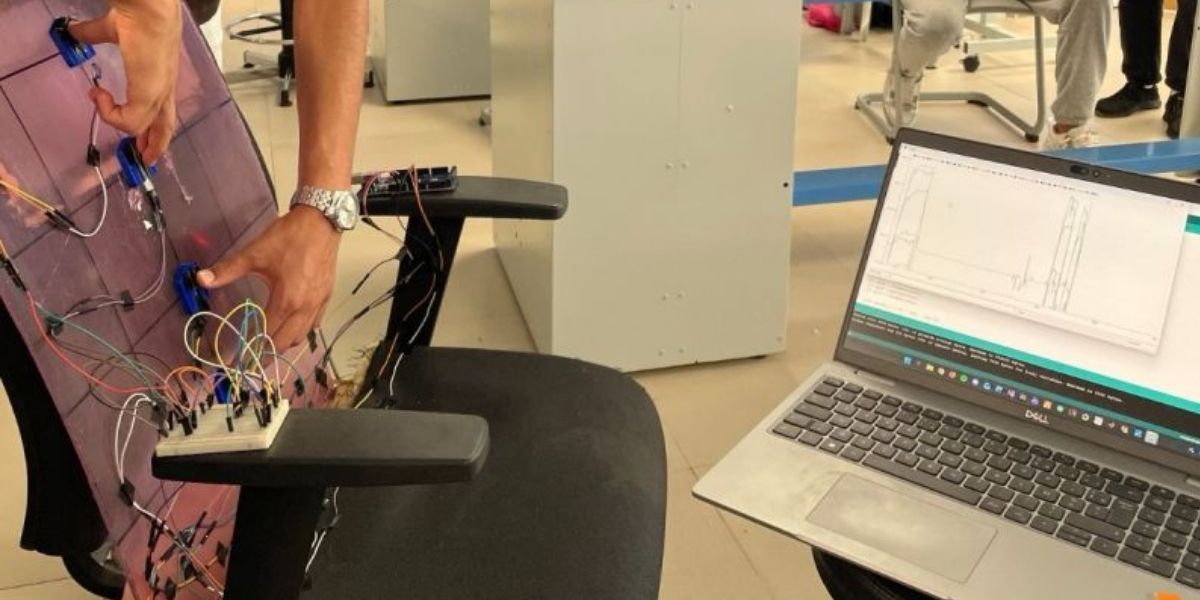
Sitting for hours can make people slowly change their posture without noticing. A Moroccan student has built a smart chair that can detect these changes and try to correct them. Mohammed Elkhannoussi, a second-year CPGE TSI student at Lycée Mohammed VI d’Excellence, developed the prototype as part of his Supervised Personal Initiative Work (TIPE). He called the project SitRight.
The chair uses pressure sensors in the seat and backrest to track how a person is sitting. The system then checks the data and decides whether the person’s position needs to be corrected.
If a correction is needed, the chair adjusts its position. The sensors then check the posture again. The process continues in a loop.
How it works
SitRight uses FSR402 pressure sensors to measure pressure on different parts of the seat and backrest.
An Arduino microcontroller reads the sensor data and controls the correction system.
Elkhannoussi used SolidWorks to design the mechanical parts and MATLAB/Simulink to model the control system. He also built the prototype, installed the sensors, programmed the Arduino and tested and calibrated the system.
The project brings together mechanical engineering, electronics, programming and control systems.
More than a normal office chair
Most ergonomic chairs depend on their design and manual adjustments. SitRight tries to make the chair react when a person’s sitting position changes.
Other systems already use cameras and sensors to detect poor posture and warn users.
SitRight is still a student prototype. It is not a medical device, and the project does not show that it can treat back pain or prevent medical conditions.
The wider smart seating market is growing. The smart ergonomic chair market was worth about $2.8bn in 2025 and is expected to reach $7.1bn by 2034, based on figures used in the project.
The global ergonomic seating market is expected to reach $13.41bn in 2026.
Researchers are also testing pressure sensors and artificial intelligence to identify different sitting positions. Some systems using pressure sensors and machine-learning models have reported an accuracy of more than 95% when identifying posture.