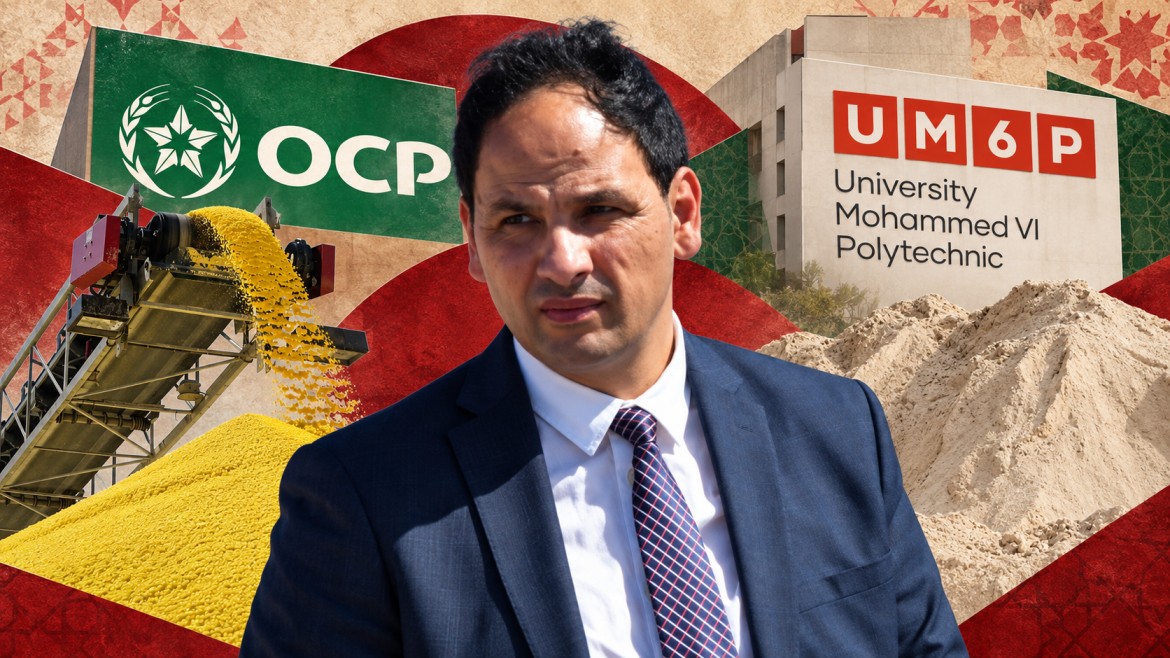
OCP is getting closer to using phosphogypsum on a large scale instead of treating it as industrial waste. The group wants to recover 100% of its phosphogypsum by 2037-2040. Research at Mohammed VI Polytechnic University (UM6P) has already produced several technologies that could make this possible. A dedicated mission led by Abdeljalil Chakir is now working on the next stage of the programme. The plan is to move step by step, from laboratory research and pilot projects to industrial-scale production.
The main focus is sulfur.
OCP wants to recover the sulfur contained in phosphogypsum and use it to produce sulfuric acid. Sulfuric acid is essential for producing phosphoric acid, which is used to make phosphate fertilisers.
The move could reduce the group’s need to import sulfur and make its supply chain less exposed to international price changes and supply disruptions.
“The interest is to close the loop: recovering the sulfur found in phosphogypsum in the form of sulfuric acid,” Professor Amina Alaoui Soulimani, who manages the phosphogypsum project at UM6P, told Médias24.
“We thus decrease our dependence on imported sulfur while valorizing an already available material.”
A large industrial byproduct
Phosphogypsum is produced when phosphate rock is turned into phosphoric acid.
The main product is phosphoric acid. The remaining material is mostly calcium sulfate, known as phosphogypsum.
For decades, the industry focused on extracting the main resource and treated the rest as waste. OCP and UM6P are now looking at the different materials contained in phosphate rock and ways to recover them.
“In a gold mine, for example, the goal was exclusively to extract, purify, and market gold, while the other elements present in the deposit were generally discarded. Today, with the scarcity of resources, this approach has changed. We must look at all the materials contained in the mine, including those previously considered residues,” Alaoui Soulimani said.
“Rather than looking for new mines, the idea is to look at what we have in our mining waste and industrial byproducts, to identify the valuable elements we can recover.”
Two main approaches are being studied.
The first is to use phosphogypsum directly. This can work for some applications, but it does not allow large quantities to be processed.
The second is to recover valuable elements from it. That approach could allow much larger quantities to be treated, but it requires technologies adapted to the specific characteristics of Moroccan phosphate rock.
Road use already tested
Phosphogypsum can already be used in several areas.
These include construction, road building and agriculture. It can also be used as a setting retarder in cement, as a component in road materials and as a soil amendment.
Japan was among the first countries to develop the use of phosphogypsum as a substitute for natural gypsum because it has limited natural gypsum resources.
A road built at the Safi industrial site in 2017 has provided a long-term test in Morocco.
The road was built using phosphogypsum aggregates and continues to carry heavy trucks, including trucks transporting acid, almost 10 years later.
“Today, the road is in magnificent condition. This proves that using phosphogypsum as a substitute for natural aggregates is technically possible,” Alaoui Soulimani said.
Environmental controls have been part of the test. Lysimeters and monitoring wells were installed along the road to check the quality of water moving through the structure.
“The results obtained so far are extremely convincing. Once compacted and integrated into the road structure with appropriate coatings, the impurities in phosphogypsum are trapped in a way that significantly limits leaching,” she said.
The use of phosphogypsum in construction still faces environmental requirements because the material can contain impurities.
Sulfur is the main priority
Sulfur recovery is currently the main strategic goal.
Producing phosphoric acid requires sulfuric acid. Producing sulfuric acid requires sulfur.
The domestic recovery of sulfur from phosphogypsum could therefore create a more closed production cycle for the fertiliser industry.
The process could also produce another useful material after sulfur extraction: a precursor for lower-carbon cement.
“Not only will we be able to recover sulfuric acid, but we can also produce a cement with a lower carbon content than cement manufactured using traditional processes,” Alaoui Soulimani said.
The technology still needs development.
Producing sulfuric acid from gypsum is not new, but traditional methods require large amounts of energy and can produce significant carbon dioxide emissions.
New processes covered by patents aim to use less energy. The challenge is to make recovered sulfur competitive with sulfur produced by the petroleum industry while making good use of the other materials left behind.
Rare earths are also being studied
Phosphogypsum contains more than calcium sulfate.
It also contains small amounts of other elements, including rare earths. These materials are important for technologies such as permanent magnets used in some wind turbines, electric motors and electronic equipment.
UM6P is studying ways to separate these different components.
“We must view the phosphogypsum stock as a mine with multiple components. One part can be enriched with rare earths, while another, purer in gypsum, can be allocated to sulfur extraction, agriculture, or construction materials,” Alaoui Soulimani said.
Researchers are also studying the use of phosphogypsum to improve degraded and salinised soils.
Tests are taking place in semi-arid areas and areas affected by soil salinity. Its structure and chemical composition could help improve some soil properties.
“Phosphogypsum is of particular interest for salinized soils. Its microstructure, different from that of natural gypsum, can make it more effective in certain treatments,” Alaoui Soulimani said.
The law is still a problem
Technology is not the only issue.
The legal status of phosphogypsum remains a major barrier to large-scale use.
The material is still classified as waste under Moroccan regulations. That means it cannot be freely used as a construction material or commercialised and exported as a normal product.
Special exemptions or experimental frameworks are currently needed for some uses.
“Today, based on regulations, I am not allowed to use phosphogypsum directly as a construction material. I can only use it in road infrastructure under an exemption,” Alaoui Soulimani said.
The classification also creates problems for exports. Products made from recovered phosphogypsum cannot move freely across borders while the original material remains legally classified as waste.
China provides one example of a different approach.
Chinese authorities have required new industrial facilities to recover their phosphogypsum fully. Existing facilities have also been given schedules to increase recovery. The policy has been combined with standards for using the material and rules allowing it to be reclassified for new uses.
A similar approach could be considered for Morocco, but the technology would need to be adapted.
Phosphogypsum does not have the same composition everywhere. Its characteristics depend on the phosphate rock and the industrial process used.
“Every phosphate is different, and phosphogypses are too. A technology may work elsewhere, but require adaptation if rare earth or heavy metal contents differ,” Alaoui Soulimani said.
From pilot projects to industry
OCP is not planning an immediate switch to full-scale recovery.
The programme is designed to grow in stages: laboratory research, laboratory pilots, industrial semi-pilots, industrial pilots and then larger production.
Sulfur recovery is moving towards the industrial pilot stage. The pilot will test technical performance, energy use and environmental impacts.
Road applications are further advanced, but transport costs remain an issue. Phosphogypsum-based construction materials become less competitive when they have to be transported over long distances.
The long-term target is clear: recover all phosphogypsum produced by OCP between 2037 and 2040.
That would help support the expected growth in phosphoric acid production, reduce dependence on imported sulfur, cut the amount of phosphogypsum that has to be stored and create new industrial activities.
“In ten years, we will realize that we considered phosphogypsum a burden, when it was actually a high-value resource we were wasting,” Alaoui Soulimani said.
The project is part of a wider change in the way OCP views its phosphate resources.
The aim is no longer only to extract phosphorus. Researchers are looking at calcium, rare earths, other metals and materials that can be used in cement, roads, agriculture and energy.
“Our mines do not contain only phosphate. They also contain limestone, rare earths, and other metals. The idea is to exploit the entire resource at all stages, from the mine to industrial transformation,” Alaoui Soulimani said.
The goal is to turn phosphogypsum from a material that needs to be stored and managed into a source of products that can be used by industry.