Morocco needs to replace its ageing training aircraft. South Korea hopes to win the deal by offering more than planes: local industrial partnerships, maintenance expertise and a role in the kingdom’s growing aerospace sector. For more than 40 years, Morocco’s Alpha Jets have helped train the pilots who would go on to fly its military’s fighter aircraft. But time has caught up with these ageing planes. As Morocco modernises its air force, it faces a practical question: how can it prepare the next generation of pilots for modern combat aircraft using training machines designed decades ago?
South Korea believes it has an answer. But it knows that selling Morocco a new aircraft may not be enough. To win the deal, it is also offering a chance to develop more aerospace expertise inside the country.
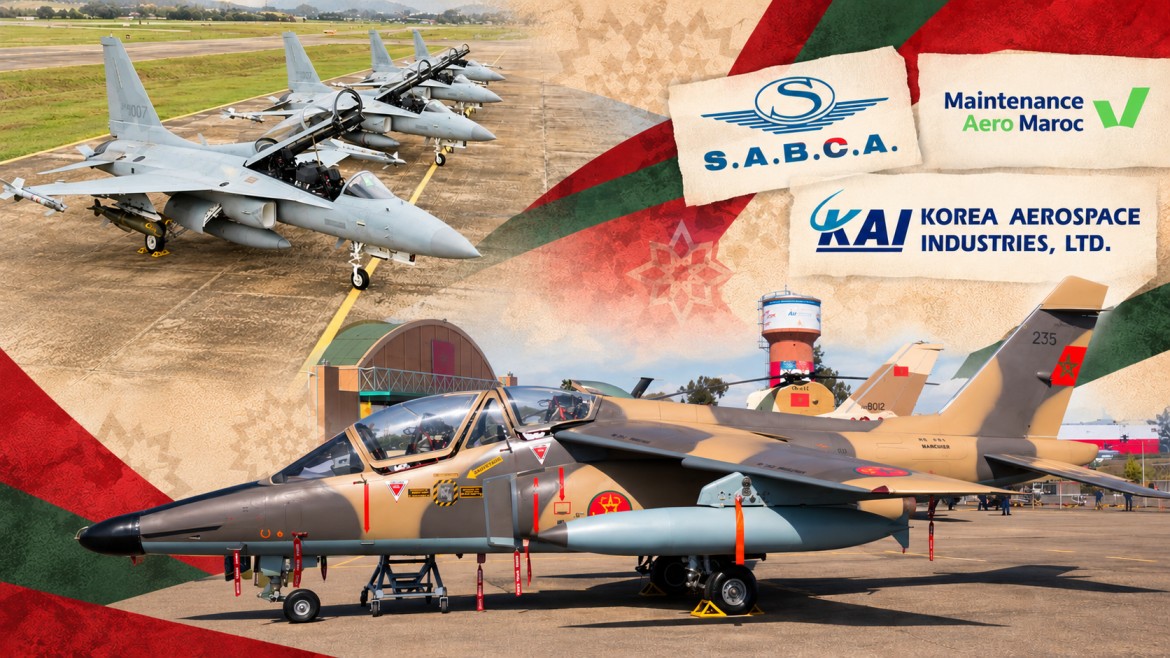
On October 8th, at the Marrakech Air Show, Korea Aerospace Industries (KAI), South Korea’s main military aircraft manufacturer, signed a memorandum of understanding with two Moroccan companies, Maintenance Aero Maroc (MAM) and SABCA Maroc to explore industrial and commercial partnerships that could strengthen KAI’s bid to supply training aircraft to the Royal Moroccan Air Force.
The aircraft at the centre of the discussions is the T-50 Golden Eagle, a supersonic jet designed to train military pilots. Its family also includes the FA-50, a version that can perform both advanced training and light combat missions.
There is, however, an important distinction between an agreement to explore a partnership and a decision to buy aircraft. Morocco has not announced an order for either the T-50 or the FA-50. No delivery date, fleet size or contract value has been confirmed.
KAI’s choice of Moroccan partners is central to its strategy. Maintenance Aero Maroc specialises in maintaining, repairing and overhauling military aircraft. SABCA Maroc, meanwhile, works in the assembly of aircraft structures. Their expertise could help KAI build a stronger presence in Morocco rather than simply export finished aircraft from South Korea.
MAM is also involved in developing a military maintenance centre in Benslimane. The facility is intended to support aircraft such as the American-made C-130 transport plane and F-16 fighter, as well as CH-47 Chinook helicopters. SABCA Maroc brings experience in manufacturing aircraft structures, with its industrial operations based in the Nouaceur area near Casablanca.
That matters because buying a fighter or trainer is only the beginning of a long relationship. Aircraft need spare parts, regular maintenance, technical support and upgrades throughout their service lives. These costs can add up over decades. A country that depends entirely on foreign companies to keep its aircraft flying may also find itself exposed to supply delays and political disputes.
Developing local maintenance capabilities can reduce some of that dependence. It can also give domestic companies experience that may be useful for future aerospace projects.
Morocco’s defence policy encourages this approach. Its Law No. 10-20, adopted in 2020, provides a framework for defence and security equipment and places emphasis on local industrial participation, technology transfer and maintenance capabilities.
Why Morocco needs a new trainer
Morocco originally acquired 24 Dassault-Dornier Alpha Jets, with deliveries taking place between 1979 and 1981. The aircraft have served for more than four decades, mainly training pilots for advanced jet flying. Roughly 19 to 22 airframes are reported to remain in service, although the precise number currently operational has not been confirmed in the material available. Over the years, maintenance and upgrades have helped keep the fleet flying. But extending the life of an old aircraft cannot solve every problem.
The Alpha Jet was designed in a different era. Its cockpit and systems reflect the technology available when it was developed in the 1970s. Morocco’s combat aircraft, by contrast, are becoming more advanced, with greater reliance on digital displays, modern sensors and systems that allow pilots to share information during missions.
Morocco operates several types of combat aircraft, including F-16s, Mirage fighters and F-5s. Its modernisation plans also include more advanced F-16 variants. The F-16 Block 72, known as the Viper, brings newer technology, including an advanced radar and improved systems for detecting and tracking targets.
This creates a growing gap between the aircraft used to train pilots and those they are expected to fly in combat. Training is not simply about learning how to control a plane. Future fighter pilots must become comfortable with complex cockpit systems, high-speed manoeuvres and the tactical decisions required in modern air combat. An advanced jet trainer can help prepare them for these demands before they move to frontline aircraft. That can reduce the pressure on expensive combat jets, which would otherwise be needed for more training hours.
The T-50 is designed for this role. Developed by KAI with American aerospace expertise, it is a supersonic trainer intended to help pilots move towards modern fighter aircraft. Its performance and design similarities to the F-16 could make it attractive to an air force that relies heavily on American-made fighters.
The FA-50 takes the idea further. It can serve as a trainer but can also be equipped for light combat missions. Depending on its configuration, it can give an air force another aircraft for certain operational tasks.
KAI is not the only manufacturer hoping to supply Morocco. Italy’s Leonardo offers the M-346 Master, an advanced jet trainer designed to prepare pilots for modern combat aircraft. One of its main attractions is its sophisticated simulation system, which can recreate elements of combat missions inside the training environment.
Pilots can practise procedures involving simulated radar, electronic warfare and weapons without having to conduct every exercise using live equipment. This can help air forces train pilots for complex missions while limiting the use of operational aircraft.
The M-346 and the T-50 family offer different approaches to the same problem. The T-50 places greater emphasis on supersonic flight and preparing pilots for high-performance fighters such as the F-16. The M-346 focuses more heavily on advanced training systems and simulated combat scenarios. Neither approach is automatically better. The right choice depends on how Morocco wants to train its future pilots.
Other manufacturers are also competing in the wider market. The Czech company Aero Vodochody offers the L-39NG, a trainer designed to provide basic and advanced instruction at a relatively accessible cost. Turkey’s Aerospace Industries is developing the Hürjet, a supersonic trainer that could become another option for countries seeking to modernise their training fleets.
Boeing and Saab have also developed the T-7A Red Hawk for the United States Air Force. Its main focus is the American military’s training programme, rather than an established campaign to supply Morocco.
Each aircraft comes with different strengths, costs and industrial arrangements. Morocco must consider not only the purchase price but also fuel consumption, maintenance, spare parts, training systems and the availability of technical support.
An aircraft that costs less to buy may become expensive to operate. A more advanced model may provide greater flexibility but require more complicated maintenance. And a plane with impressive specifications may still be the wrong choice if it does not fit the air force’s training needs.
There is also a diplomatic dimension. Buying military aircraft often creates long-term ties between countries. The customer becomes dependent on the supplier for parts, repairs, upgrades and, in some cases, permission to use or export certain technologies.
South Korea has experience—but no guarantee
KAI enters the competition with a growing export record. In September 2022, Poland signed a deal worth about $3bn for 48 FA-50 aircraft. Malaysia signed a contract worth roughly $920m in February 2023 for 18 FA-50s. The Philippines has received 12 FA-50PH aircraft and has discussed acquiring 12 more. Thailand operates 14 T-50TH advanced trainers, while Indonesia operates 16 T-50i aircraft developed within a broader partnership.
At the Marrakech Air Show, the company gave the FA-50 a dedicated display area as it sought to attract Moroccan interest. According to South Korea’s Asia Business Daily, the stand received visits from Abdeltif Loudiyi, Morocco’s minister delegate in charge of National Defence Administration, as well as senior officials from the Royal Armed Forces and the Royal Moroccan Air Force.