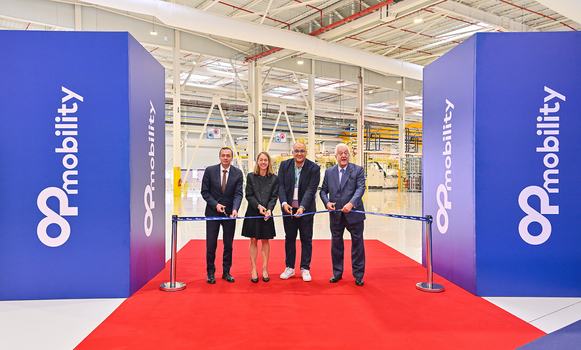
More than 100 people are set to find work at a new car parts factory in Kenitra, as French supplier OPmobility expands production in Morocco despite falling demand in the global car industry. The company opened the plant in the Atlantic Free Zone. It will make exterior body parts for a major international carmaker, using automated systems to manufacture, move and store components.
The new facility brings OPmobility’s number of plants in Morocco to four, with two in Kenitra and two in Tangier. Its workforce in Kenitra will rise to 510, while the total number of employees across the country will exceed 1,400.
“Since establishing our activities in Morocco, we have developed strong industrial expertise and built highly qualified and committed local teams,” said Félicie Burelle, the company’s chief executive.
Burelle attended the opening alongside chairman Laurent Burelle and members of the company’s board of directors.
The new factory is close to OPmobility’s existing Kenitra plant, which opened in 2018. It will support local manufacturing, maintenance, logistics and quality control.
The company has operated in Morocco since 2013. Its four plants produce energy storage systems, vehicle lighting components and exterior body parts for major carmakers, including Renault, Stellantis and Volkswagen.
OPmobility expanded its operations in Tangier in 2022 by acquiring Varroc Lighting Systems.
The new jobs come as OPmobility faces weaker demand and falling vehicle production in global markets.
On 7 October, the company lowered its target for 2026 operating margin — a measure of profit from its core business — from €490m to between €430m and €450m.
It said global automotive market conditions had deteriorated more sharply than expected and vehicle production volumes were falling. The company also announced plans to cut about 770 jobs across its European operations to protect its cash flow.
On 19 October, the same day as the Kenitra plant opening, S&P Global Ratings downgraded OPmobility’s credit rating from BB+ to BB, reflecting increased concerns about its credit risk.
The contrast is clear: the company is creating more than 100 jobs in Morocco while planning to cut about 770 positions in Europe.
OPmobility is also seeking growth through acquisitions. On 30 September, it signed a definitive agreement to buy Hyundai Mobis’s lighting division for 600bn South Korean won, or about $434m.
The division generated $1.78bn in revenue in 2025. The deal would add five manufacturing plants in South Korea, China, Mexico and the Czech Republic, strengthening OPmobility’s presence in Asia and North America.
The acquisition builds on the company’s existing lighting business, which expanded in 2022 with the purchase of Varroc Lighting Systems.
Founded in 1946 by Pierre Burelle, OPmobility was known as Plastic Omnium until it changed its name in March 2024 to reflect its broader business.
The company reported €11.5bn in economic revenue in 2025. It operates 152 manufacturing plants and 40 research and development centres, employing 38,100 people in 28 countries.
Its products include vehicle bumpers, grilles, tailgates and spoilers, as well as lighting systems and energy storage technologies. These include fuel tank systems for conventional and hybrid cars, battery enclosures for electric vehicles and hydrogen storage systems.
The company also supplies integrated front-end modules through HBPO, which it owns in full. These modules combine several components at the front of a vehicle into a single assembly.
The new factory strengthens Morocco’s role as a production base for international carmakers and their suppliers. Manufacturing exterior body parts close to vehicle assembly plants can reduce transport costs and help ensure components arrive when they are needed.
The Atlantic Free Zone in Kenitra is part of the country’s automotive industrial network, which includes major vehicle assembly operations such as Stellantis.
OPmobility’s Moroccan plants supply components to major carmakers operating in the region, while its global operations serve the wider automotive industry.
The company is due to publish its third-quarter 2026 revenue figures on 21 October, offering investors an update on its performance amid weaker vehicle production and its ongoing expansion plans.