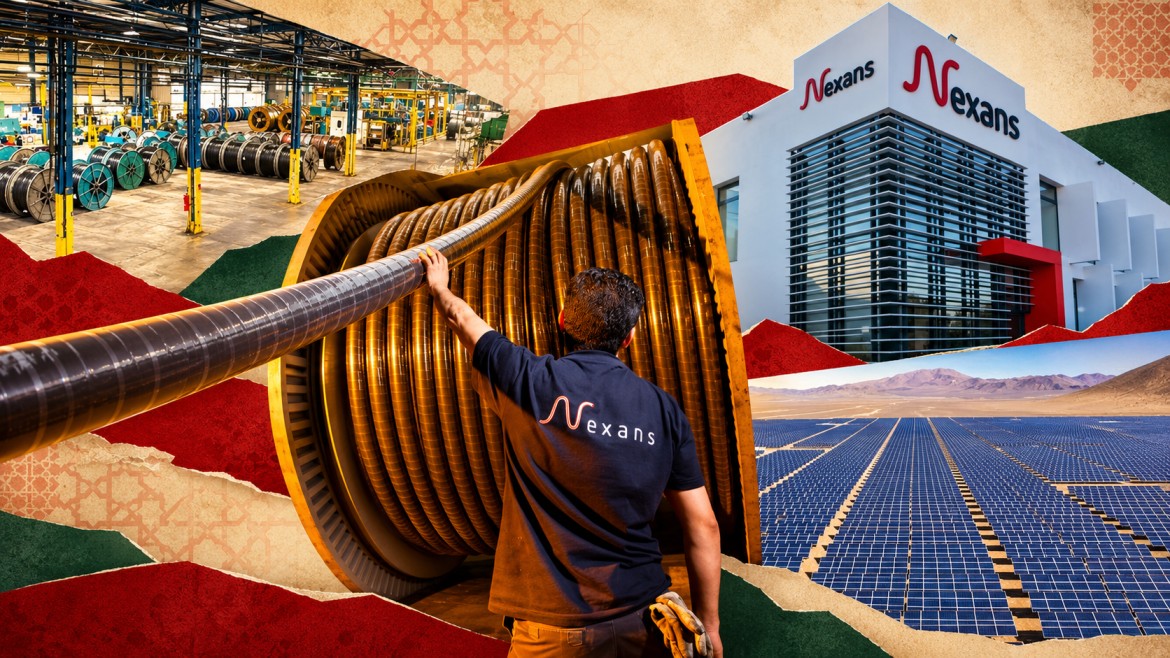
Morocco’s solar power projects are helping French cable maker Nexans grow its electrical networks business, as the company expands its role in supplying equipment for renewable energy and electricity grids. Nexans reported a 14.8% rise in sales in the division during the third quarter of 2026, reaching €363.9m, compared with €314.4m in the same period last year.
The figures, published on 22 October, measure growth at constant scope and exchange rates. The company said major solar projects in South America, Turkey and Morocco had helped drive the increase.
Nexans recorded nearly €5bn in total sales during the first nine months of 2026. Its electrical networks division generated €1.066bn over the same period, an organic increase of 8.1%.
Europe remained the main driver of growth, supported by increased industrial capacity. Orders from electricity grid operators and demand from data centres also boosted activity in North America. Nexans did not disclose separate revenue figures for its Moroccan operations.
Nexans is supplying cables and electrical equipment for Noor Atlas, a programme covering six solar power plants with a combined capacity of 305 megawatts (MW).
The specialist publication pv magazine France reported in April that Nexans and its partners had won contracts to supply the equipment.
The plants are planned for Aïn Béni Mathar, Boudnib, Bouanane, Enjil, Tata and Tan-Tan. Their cables will collect the electricity generated and carry it to the national grid.
Nexans says the equipment is designed and manufactured locally. The first plants are scheduled to begin operating in July 2027.
The programme is part of efforts to expand solar power across different regions of the country, rather than concentrating generation at a few large sites. Connecting plants in remote areas to the national grid requires cables and other electrical infrastructure.
Morocco aims to obtain 52% of its installed electricity capacity from renewable sources by 2030.
Nexans announced a €100m investment in Morocco in December 2023 to expand medium-voltage cable production.
The company operates through its subsidiary Nexans Maroc, which has production facilities in Casablanca and Mohammedia. Medium-voltage cables help connect power plants to regional substations and electricity networks.
Producing cables locally can reduce transport costs and reliance on imported equipment. It can also help suppliers meet local-content requirements for infrastructure projects.
Morocco is preparing further investment in its electricity grid as renewable energy capacity grows. One proposed project is a 3-gigawatt high-voltage direct current (HVDC) link connecting the renewable-rich southern provinces, including Dakhla and Laayoune, with industrial centres in the north, including Casablanca and Tangier.
The proposed link could create additional demand for cables and transmission equipment. However, no contract awarded to Nexans for the project has been identified in the information available.
Nexans’ expanded manufacturing capacity in Morocco could also help it supply customers in West Africa and Europe.
European Union rules on carbon emissions and imports could increase the importance of the environmental footprint of industrial products. Cables made in Morocco using renewable electricity could offer a lower-carbon supply option, although no figures have been provided to quantify this potential advantage.