A Swiss-Moroccan man who calls himself “King of Switzerland” has built a self-styled empire made up of scattered plots of land across the country, attracting both amusement and irritation in equal measure.
Jonas Lauwiner, 31, also uses a string of invented titles including “Emperor of the Lauwiner Empire” and “Field Marshal of the Empire Legion”. He has even been elected to the municipal council of Burgdorf, a small Swiss city, where he appeared on the ballot under the name “Konig Jonas Lauwiner”.
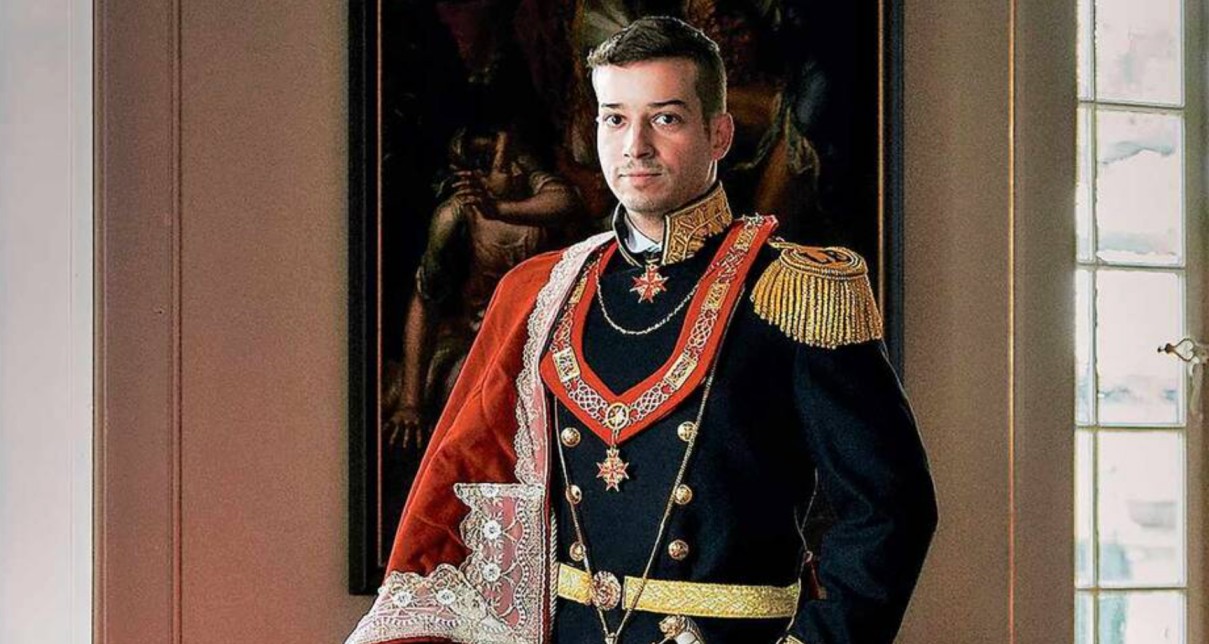
In photographs on his website, he poses in a mock military uniform and displays a range of self-awarded honours, including what he calls the Empire Order of Merit.
Despite the theatrical presentation, most of his so-called empire is real estate. His holdings amount to around 150 plots spread across nine Swiss cantons, including fields, roads and building land.
Lauwiner says the project began with a small parcel of land gifted by his father on his 20th birthday. He later expanded his holdings by using Swiss legal provisions that allow ownerless land to be claimed, paying only administrative fees.
From there, he began what he calls a “campaign” of acquisitions, gradually building what he now describes as a land empire.
In 2019, he staged a self-coronation ceremony at Nydegg Church in Bern, attended by supporters and presided over by a figure he calls the “First Bishop of the Empire”.
His headquarters, listed online as a royal palace, is in fact an old paint factory near Burgdorf, which he reportedly acquired for a modest registration fee.
The project blends performance and property ownership. Lauwiner issues symbolic currency, including an “Imperial Vellar” coin, and claims to command a military unit known as the Empire Legion, which he describes as a land, air and sea force, despite Switzerland being landlocked.
He also attempts to charge fees linked to land use, including infrastructure access and planning permissions. He has told French broadcaster France 24 that he does not profit from roads, though he admits selling them at times.
Some locals have taken issue with those claims, particularly where roads are involved, saying attempts to impose charges have caused friction in affected communities.
Others appear more amused than alarmed. In 2024, he was elected to Burgdorf’s city council, securing 689 votes.
Lauwiner has also promoted an elaborate genealogy on his website, tracing his lineage back to medieval European rulers. Historians are unlikely to endorse the claims.
Born in Switzerland to a Swiss father and Moroccan mother, he previously worked in IT project management. His mother, a former Moroccan gymnast, competed internationally in the early 1980s.
While much of the imperial narrative is clearly fictional, the land ownership is not. Switzerland’s federal system allows private individuals to hold fragmented plots across multiple cantons, which Lauwiner has used to expand his portfolio.
His story sits in a long tradition of self-declared monarchs, from 20th century African strongmen with grandiose titles to European pretenders to defunct thrones. Most have ended in obscurity rather than sovereignty.
For now, Lauwiner continues to run what he calls a full-time “empire”, balancing civic politics, property management and performance. In Switzerland’s orderly landscape, it is an unusual form of monarchy, but one conducted firmly within the boundaries of the law.