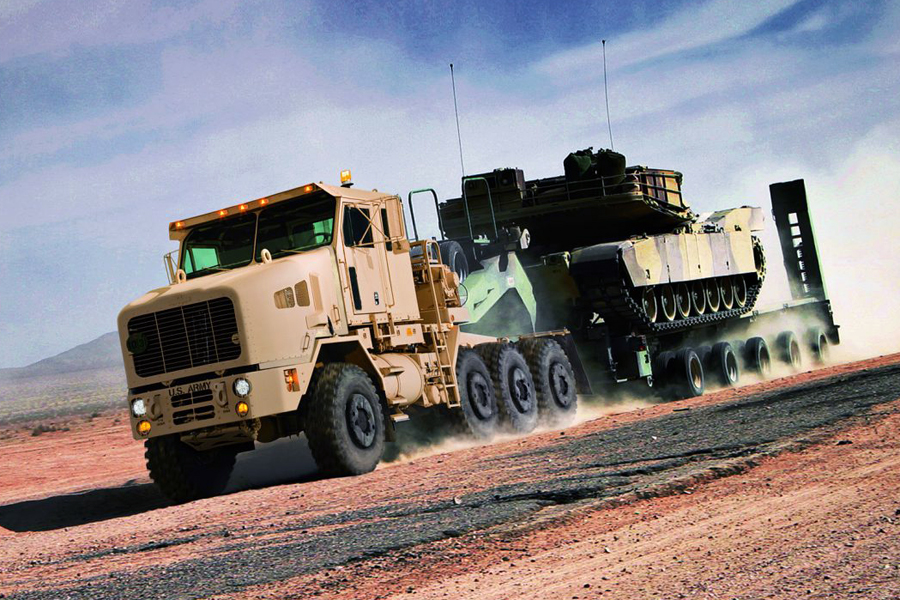
Morocco is buying 50 heavy military transporters and 50 heavy-duty trailers to help the Royal Armed Forces (FAR) move and recover tanks and other heavy equipment. US defence company Oshkosh Defense has received a follow-on order from Optimum Vehicle Logistics for the FAR. The order covers 50 HET A1 heavy equipment transporters and 50 MN573 heavy-duty trailers.
The package also includes spare parts, services and training.
The actual price of the order has not been disclosed. Based on US military procurement figures and prices for similar vehicles sold under other defence contracts, the full package could be worth about $55m to $70m, or roughly 550m to 700m Moroccan dirhams.
That figure is only an estimate. It is not the official value of the Moroccan order.
The HET A1, also known as the M1070A1, is an 8×8 military truck designed to transport heavy armoured vehicles. Similar US procurement data puts the basic cost of an M1070A1 tractor at around $500,000 to $600,000, with a figure of about $550,000 often used for the vehicle itself.
The Broshuis MN573 trailer is designed to carry more than 70 tonnes, or more than 140,000lb, of military equipment. Similar heavy military trailers are estimated to cost about $350,000 to $500,000 each, depending on their configuration and technical equipment.
That puts the estimated price of one complete tractor-and-trailer combination at about $900,000 to $1.1m.
For 50 complete systems, the estimated cost would therefore be around $45m to $55m before the additional package of spare parts, training and support services.
Such support can add another 15% to 30% to the value of a defence contract. That is the basis for the wider estimate of $55m to $70m.
The HET A1 is powered by an 18.1-litre Caterpillar C18 diesel engine producing 700 horsepower. It uses an Allison 4800SP seven-speed automatic transmission and an Oshkosh 30000-series single-speed transfer case.
The truck has 8×8-wheel drive and power-assisted steering across multiple axles. This helps the vehicle manoeuvre while carrying very heavy loads.
Two hydraulic winches are fitted behind the cab. Together, they can pull up to 110,000lb (50,000kg). They can be used to pull disabled tracked or wheeled vehicles onto the trailer.
The HET A1 has an air-conditioned, armour-ready LTAS cab. It can carry up to six people: a driver, co-driver and four other crew members.
The vehicle has a range of up to 325 miles (523km). Its maximum speed at full gross weight is about 45-50mph (72-80km/h).
The MN573 trailer is made by Dutch manufacturer Broshuis B.V. It uses several axles, hydropneumatic suspension and hydraulic steering on the rear axles.
The design spreads the weight of a heavy vehicle across several axles. This helps reduce pressure on roads and the ground while carrying very heavy loads.
The trailer also has a low-loader platform with a low drive-on angle. This makes it easier to load and unload tracked military vehicles.
The new systems will mainly improve logistics rather than add new firepower.
Main battle tanks and heavy artillery can move under their own power, but doing so over long distances uses fuel and increases wear on engines, tracks and other components.
Heavy transporters allow those vehicles to travel long distances by road without relying on their own engines and tracks for the entire journey. This can help preserve combat vehicles and reduce maintenance needs.
The transporters can also move heavy equipment between different areas more quickly. Their recovery capability means damaged or stuck vehicles can be pulled onto a trailer and taken away for repairs.
The combination of the HET A1’s 8×8 drive and the MN573’s multi-axle trailer is designed for difficult routes, including paved roads, unpaved logistics routes, desert tracks and steep terrain.
The order does not confirm plans for a particular military operation. Its immediate effect is to give the FAR more capacity to move, recover and maintain heavy equipment.
For an armoured force, that capacity matters. Tanks and artillery need a large logistics network to keep them fuelled, repaired and mobile. More heavy transporters can help the FAR move its existing equipment while reducing unnecessary wear on the vehicles themselves.