
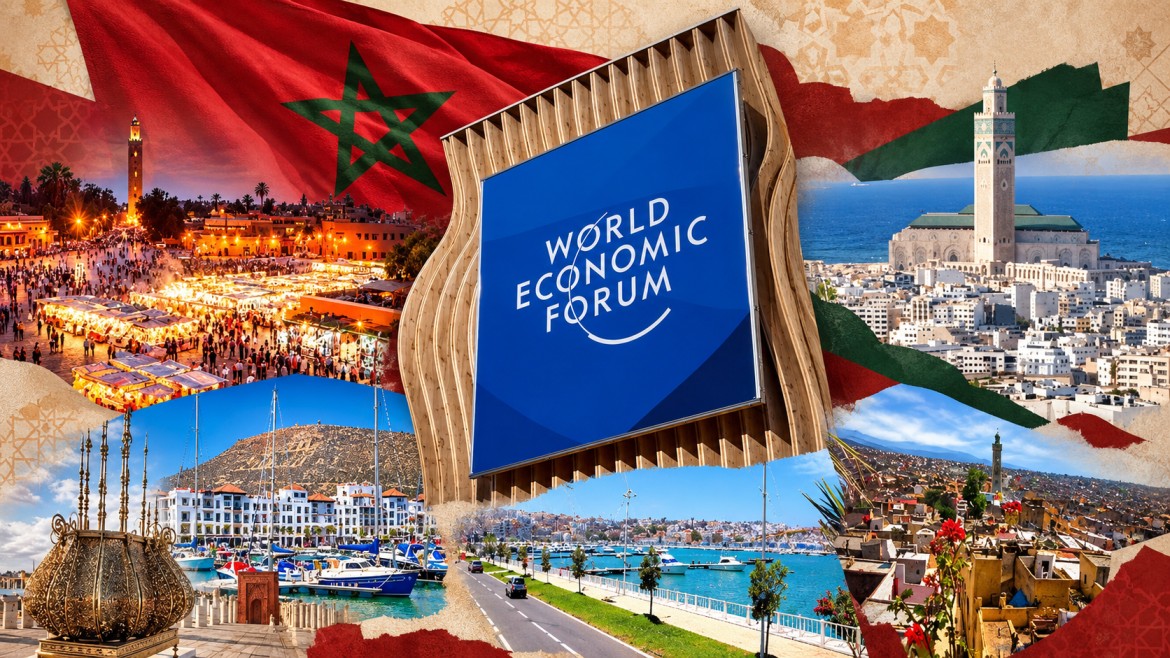
Morocco has moved up seven places in the World Economic Forum’s 2026 Travel & Tourism Development Index, ranking 70th out of 110 economies. The country scored 3.84 out of seven, up 5.5% from 2024. The increase was more than twice the global average of 2.1%.
The index does not measure the number of tourists, hotel nights or tourism revenue. It looks at the conditions that help tourism grow and remain sustainable. These include business conditions, safety and health, skills, the labour market, tourism policies, international openness, prices, environmental sustainability, transport infrastructure, tourism services, and cultural and natural resources.
Morocco ranks second in North Africa, behind Egypt, which is 63rd globally with a score of 3.97. Tunisia ranks 82nd with 3.62, while Algeria is 89th with 3.52.
Morocco also recorded the fastest improvement among the four North African countries covered by the index. The score rose 5.5% between 2024 and 2026, compared with 3.6% for Algeria and 2.1% for Egypt. Tunisia recorded a 0.2% decline.
The wider tourism sector has also improved. Some 92% of the economies covered by the index recorded higher scores between 2024 and 2026. Only about 54% had improved between 2021 and 2024. The average increase reached 2.1%, the strongest growth recorded since the Covid-19 pandemic.
North Africa saw a particularly strong improvement in cultural resources. The region’s score in this area increased by 18% between 2024 and 2026. That was one of the biggest increases in the world, behind Southeast Asia, where the score rose by 26.5%.
Tourism demand is also shifting towards cultural experiences. Heritage sites, food, museums, festivals, local traditions and the arts are attracting more interest. Digital demand linked to cultural and entertainment attractions increased by about 15% worldwide between 2024 and 2026.
The Middle East and North Africa, or MENA, recorded an average score of 3.98 out of seven in 2026, up 2.5% from 2024. Asia-Pacific recorded stronger growth at 3.6%. Europe and Eurasia increased by 1.8%, the Americas by 1.6% and sub-Saharan Africa by 1.1%.
The United Arab Emirates ranked highest in MENA at 22nd globally, with a score of 4.56. Saudi Arabia followed in 29th place with 4.45. Qatar ranked 47th, Bahrain 55th and Oman 62nd. Egypt ranked 63rd, Morocco 70th and Jordan 73rd.
The Middle East had an average score of 4.10, compared with 3.74 for North Africa. Air transport infrastructure and digital readiness were among the areas where the Middle East had a clear lead.
North Africa had stronger price competitiveness. The region scored 5.60 in this area, compared with 4.41 for the Middle East.
The gap was much wider in air infrastructure. North Africa scored 3.83, compared with 5.02 for the Middle East. Digital readiness showed a similar difference, with scores of 4.47 and 5.75 respectively.
Japan ranked first in the 2026 global index with a score of 5.27. The United States ranked second with 5.23, followed by Spain with 5.22, Australia with 5.18 and France with 5.17. Germany, the United Kingdom, China, Switzerland and Italy completed the top 10.
Global tourism has also returned to record levels. International tourist arrivals reached 1.5 billion in 2025, up 5% from 2024 and 4.4% from 2019.
Travel and tourism generated $11.6tn in economic activity in 2025, equal to almost 10% of global GDP. The sector supported 366 million jobs, or about one in every nine jobs worldwide.
The sector also faces higher costs and growing pressure on infrastructure and resources. Price competitiveness declined in three-quarters of the economies covered by the index between 2024 and 2026. Higher transport, accommodation, energy and labour costs are putting pressure on tourism businesses and destinations.
Investment needs and skills shortages remain other concerns.
The main challenge for tourism destinations is now to manage growth without putting too much pressure on infrastructure, local communities and natural resources.
The 2026 ranking shows better conditions for tourism development in Morocco, while the 70th global position also points to areas that still need improvement, particularly air infrastructure and digital readiness when compared with the strongest-performing destinations in the Middle East.