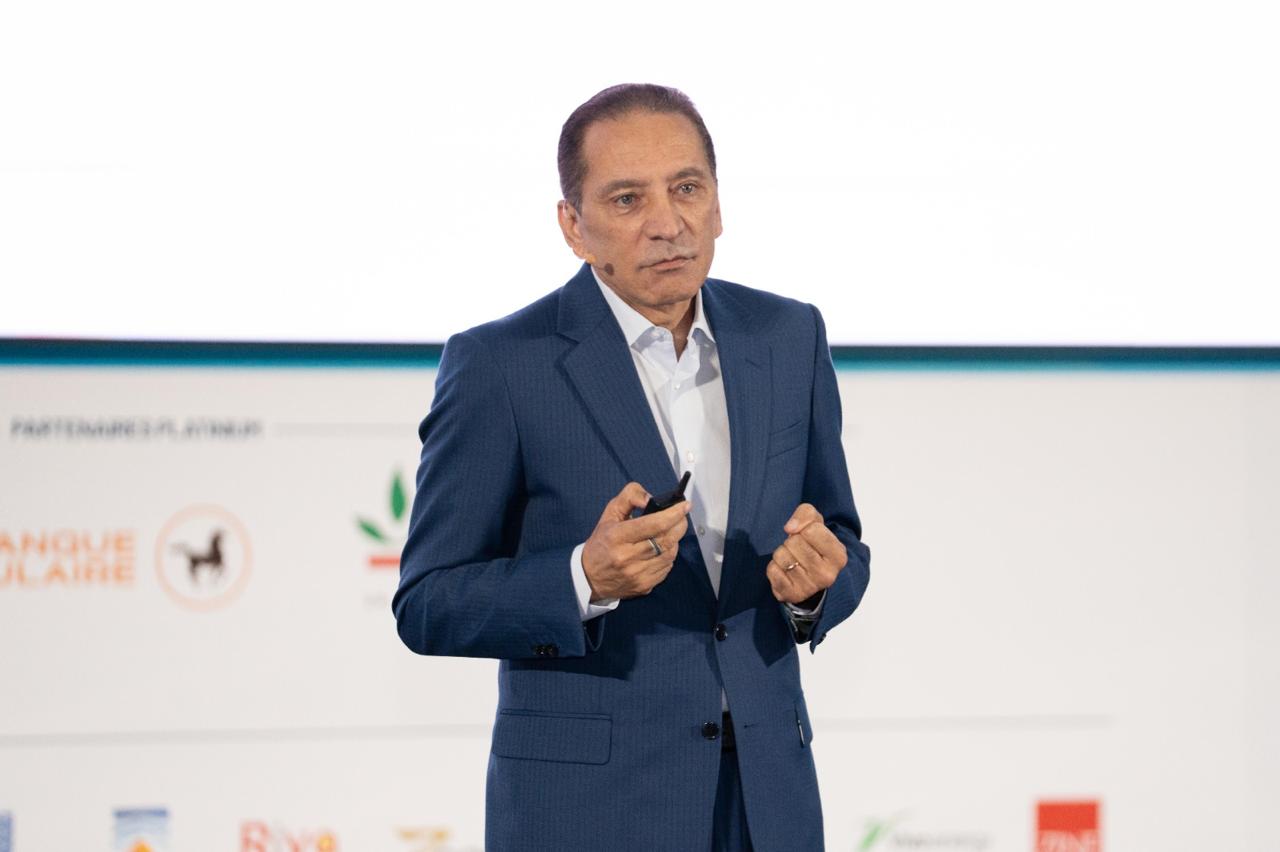
Morocco must rethink its industrial strategy to protect jobs from artificial intelligence, businessman Moulay Hafid Elalamy has warned, saying the technology is already threatening workers and the country cannot afford to stand still.
“I am worried today. If we do not get back on track and look for genuinely new strategies, I am worried,” he said on Saturday, 17 October, at the General Confederation of Moroccan Enterprises (CGEM) forum, Entrepreneurs en mouvement, in Casablanca.
“Because artificial intelligence will kill some jobs. This is not science fiction. It is happening today.”
“I am talking about the Global South. I am talking about us,” he added.
Elalamy, founder of Saham Group and chairman of Teleperformance, did not offer specific solutions. But his warning comes as a new government takes office and prepares to set its priorities. He previously helped shape the country’s industrial strategy around sectors such as car manufacturing and offshoring, while the call-centre industry he now leads faces growing pressure from AI.
‘I want you all to become very rich’
Elalamy also urged business leaders to build their companies and create wealth, arguing that governments should support entrepreneurs rather than treat them as a problem.
“For 20 years, I have been warning against falling into the trap of certain countries that smear entrepreneurs. Those are dying countries. When you set capital against value creation, that is the beginning of the end,” he said.
He argued that the state should ask business owners to meet clear ethical responsibilities: pay their taxes, look after their employees and contribute to the national social security system, known as the CNSS.
“But they must do business,” he said.
Elalamy recalled a dispute with former French minister Brice Hortefeux, who had challenged him over his call for business owners to become rich.
“I stand by that completely. I want the CGEM to have rich business owners. I want all of you to become very, very rich,” he told the audience.
“But ethical,” he added.
His argument was that the more successful businesses become, the more tax they pay, allowing the state to redistribute more money.
He said he had told Hortefeux that he would come to France to teach him how to distribute poverty, adding that he believed Morocco knew how to distribute wealth.
“You have understood that I make a lot of enemies. I accept that,” he said.
Elalamy warned business owners to keep their records in order and comply with the tax authorities, customs, the Foreign Exchange Office and the CNSS. A single breach, he said, could undermine a business built over many years.
“One loophole is enough,” he warned, adding that past problems could come to light when a company tried to expand.
‘I am ready to go to prison in your place’
Elalamy also described the difficulty of getting government officials to make decisions when he became a minister.
He said he found an administration where officials were afraid to sign documents because they feared being questioned later by the Court of Auditors.
One official explained the problem to him: “If I say yes, the Court of Auditors will come one day and ask me why. If I say no, nobody will ask me anything.”
Elalamy said he replied: “I am paid to do this. I am ready to go to prison in your place. Give me the files to sign.”
After three or four weeks, he said, officials had “felt ashamed” and started signing documents again.
He shared the story as a new government prepared to take office. King Mohammed VI had appointed the El Mansouri government the previous day, according to Elalamy’s account at the event.
At the start of his speech, he had joked that the absence of government officials would allow business leaders to speak freely.
“Thank God, the people from the government are not here today, because there are handovers taking place. So we can talk among ourselves. We can say anything.”
Family businesses must plan for succession
Elalamy also criticised business owners who hold on to family companies even when selling them might be the best option.
“I have a problem with Moroccan entrepreneurs,” he said.
He challenged the idea that a company should never be sold simply because it was founded by a parent or grandparent.
“Your grandfather was an entrepreneur. If he were still alive, he would probably have sold it before it went bankrupt,” he said.
He criticised the appointment of children to lead companies when they had neither wanted the job nor earned the experience needed to do it. He also questioned the practice of keeping lawyers and bankers because of family loyalty, and treating the division of an inheritance as a plan for business succession.
“These are ranks you earn, not ranks you are given,” he said.
“I am looking for the third generation of people who created wealth and passed it on,” he added.
Lessons from business failures
Elalamy said his advice came from his own experience, including mistakes as well as successes.
He recalled a healthcare venture that had been launched “with an engine to accelerate towards a wall”.
He contrasted that failure with Phone Assistance, a company that started with 2 million dirhams and eventually became part of Teleperformance, the global company he now chairs.
His keynote speech, titled The Audacity to Think Big, was billed as a set of ten rules drawn from lessons he had learned the hard way.
The talk covered business growth, ethical conduct, government bureaucracy and family succession. But his warning about AI stood out: without new industrial strategies, he said, the jobs and businesses built over the past decades could be at risk.